Sustainable Textile Manufacturing Practices Above 10t/day
How UK permitting and ZDHC controls shape heat, water and chemical use.
Sustainable textile manufacturing practices are engineered methods for reducing energy, water, chemical use, emissions and waste per unit of textile produced while maintaining product quality and throughput.
For UK wet-processing sites, the 10 tonnes-per-day threshold has regulatory weight. Schedule 1, Section 6.4 of the Environmental Permitting (England and Wales) Regulations 2016 classifies the pre-treatment or dyeing of fibres or textiles above that capacity as a Part A(1) activity. This includes washing, bleaching, mercerisation and dyeing.
The threshold changes the nature of sustainability work. Energy, water, emissions and chemical management cannot sit as separate improvement projects. They need to form part of how the dye house, boiler house, stenter operation and effluent treatment plant are engineered, operated and measured.
A practical programme starts with the production line, not a generic carbon target. It asks where heat enters the mill, where water enters the process, where chemicals become effluent, and where usable energy leaves through exhaust stacks, condensate lines, drains and warm wastewater.
Why Sustainable Textile Manufacturing Practices Matter Above 10t/day
The Part A(1) threshold raises the compliance bar
A textile site processing more than 10 tonnes per day through pre-treatment or dyeing falls within Part A(1) of Section 6.4. Environmental permitting therefore becomes central to operating decisions, particularly where a plant discharges trade effluent, emits combustion products or volatile organic compounds, generates sludge, or consumes significant quantities of gas and water.
Permit conditions are site-specific, but the Environment Agency expects operators to apply best available techniques, monitor relevant emissions and maintain suitable environmental management arrangements. A mill should therefore treat its permit, boiler controls, wastewater monitoring plan and production records as connected operational documents.
The European Commission’s 2022 Best Available Techniques Conclusions for the textiles industry provide a useful technical benchmark, even though UK permit obligations arise under domestic legislation. The document addresses water use, emissions to water and air, energy consumption, chemicals, waste and process monitoring across textile pre-treatment, dyeing, printing and finishing.
Measure performance by process, not by monthly utility bill
A monthly gas bill cannot explain whether energy rose because of colder weather, a heavier fabric construction, lower machine loading, a different dye recipe or an inefficient dryer. Useful sustainable textile manufacturing practices need process-level data.
For a dye house, the relevant boundary may include:
- Steam and hot water used for preparation, dyeing, washing and rinsing
- Electricity used by pumps, circulation systems, compressed-air equipment and extraction fans
- Water intake by machine, recipe and batch
- Effluent flow, temperature, conductivity, pH, chemical oxygen demand and colour
- Production tonnes, metres, batch count and quality rework
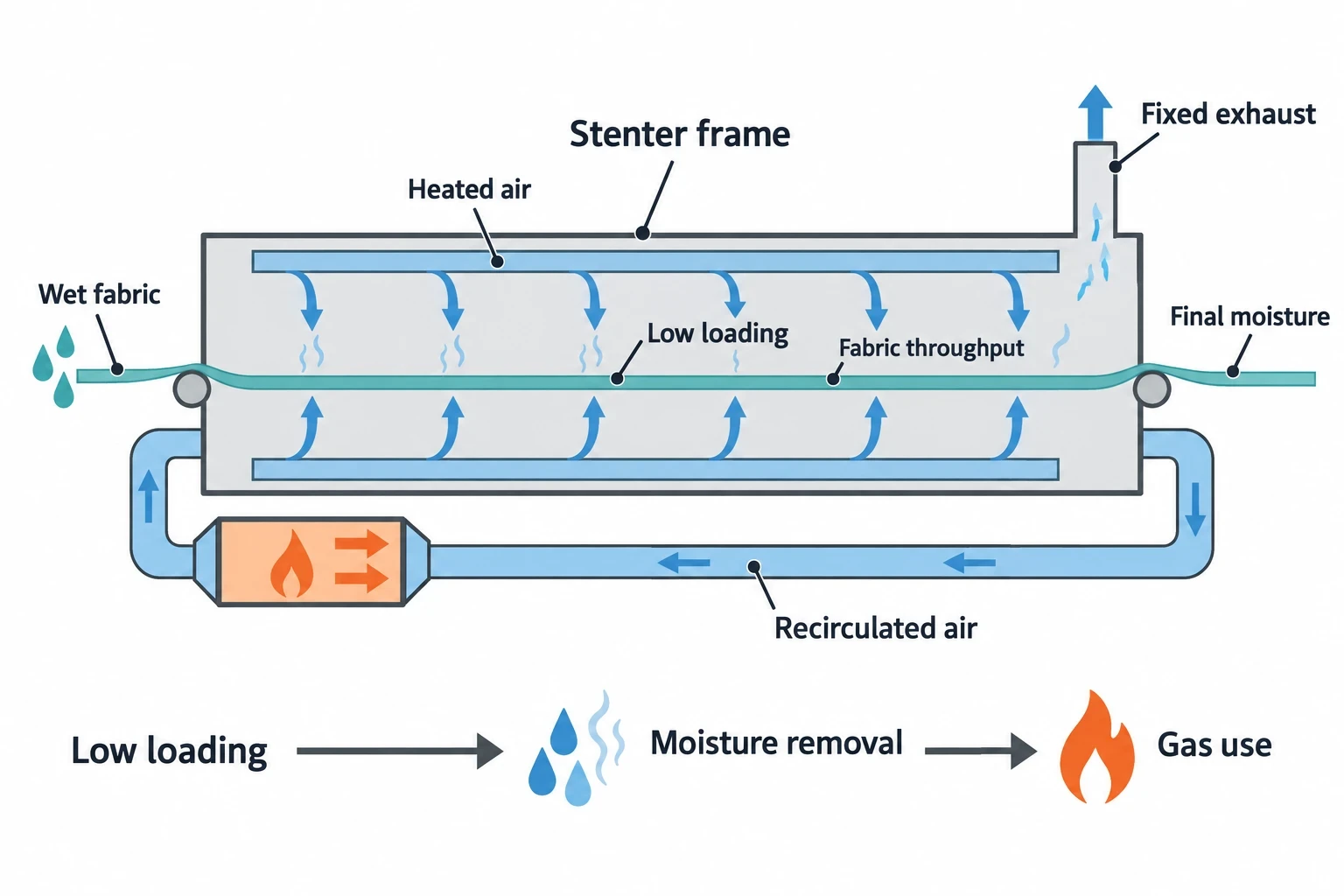
For a stenter frame, the key relationship is between fabric throughput, moisture removal, exhaust volume, gas use, recirculated air, set-point temperature and final moisture content. Low fabric loading at a fixed exhaust rate can raise energy use sharply without an equivalent production benefit.

Identify where your plant is losing energy and quantify the savings potential — our audits map every heat source, sink, and waste stream in your facility.
Energy Efficiency in Textile Wet Processing and Finishing
Start with an energy audit of the thermal system
Textile energy use is often concentrated in steam generation, hot-water production, dyeing vessels, washing ranges, drying, heat-setting and stenter frames. A site may also carry substantial electrical demand from motors, extraction systems, pumps, compressed air and chilled-water plant.
An industrial energy audit should establish a production-adjusted baseline before proposing capital expenditure. This means examining utility consumption alongside batch schedules, fabric weights, fibre blends, shades, operating temperatures and machine utilisation.
EnerTherm Engineering’s seven-step textile audit approach begins with consultation and baseline establishment, followed by on-site assessment using portable power analysers, ultrasonic leak detectors and thermal imaging. It then uses energy modelling and thermal simulation to identify conservation measures, prepare a report, support implementation and verify results through ongoing measurement and verification.
This approach prevents a common error: specifying heat recovery equipment before confirming that enough recoverable heat is available, at a useful temperature, for enough operating hours.
Improve boiler, steam and condensate performance
Boiler plant remains a major source of direct emissions at textile mills. The best opportunities often sit in basic system control rather than boiler replacement.
Plant engineers should review combustion efficiency, excess oxygen, flue-gas temperature, blowdown practice, steam pressure and condensate return. Steam traps need a managed inspection programme because failed-open traps waste steam, while failed-closed traps can create poor heating performance and water hammer.
Condensate recovery can reduce boiler fuel, treated make-up water and chemical demand where condensate quality permits return. The assessment must include contamination risk. Condensate exposed to dyes, auxiliaries or heat-transfer contamination needs testing before it returns to the boiler house.
Reduce stenter-frame and dryer losses
Stenter frames remove large quantities of water from fabric while exhausting hot, humid air to atmosphere. The exhaust stream can contain recoverable heat, but recovery design needs to account for lint, oils, finishing chemicals and fouling.
Common measures include:
- Maintaining seals, doors and fabric-entry openings to reduce false-air ingress
- Adjusting recirculation and exhaust settings to match fabric moisture and production rate
- Matching burner output to actual thermal demand
- Cleaning heat exchangers, filters and ducting to control pressure drop
- Recovering exhaust heat to preheat fresh air, process water or boiler make-up water
- Monitoring final fabric moisture to avoid overdrying
Heat recovery must not compromise product quality or create cross-contamination. A plate or run-around coil system may suit applications where direct contact between process exhaust and fresh air would create an unacceptable risk.
| Textile system | Typical loss or inefficiency | Engineering response | Quality safeguard |
|---|---|---|---|
| Stenter frame | High-temperature humid exhaust | Recover heat into incoming air or process-water circuit | Check fabric moisture, shade and handle |
| Batch dyeing | Excess steam use and long heating cycles | Optimise heating ramps, loading and insulation | Confirm recipe reproducibility |
| Boiler house | High flue-gas temperature or low condensate return | Tune combustion and improve condensate recovery | Test condensate quality |
| Hot-water network | Continuous circulation and distribution losses | Insulate lines, control pumps and repair leaks | Protect required machine temperature |
| Compressed air | Leaks and inappropriate air use | Survey leaks and replace air-driven functions where practical | Verify machine safety and reliability |
Water, Chemicals and Wastewater in Sustainable Textile Manufacturing Practices
Reduce water use before investing in treatment capacity
Water reduction starts at the machine. Lower-liquor-ratio dyeing, accurate chemical dosing, counter-current washing and rinse-water reuse can reduce fresh-water demand and the volume of effluent requiring treatment.
These measures require disciplined recipe management. A reuse stream acceptable for a first wash may cause a colour, salt or contamination problem if sent to a pale-shade process. Mills should classify water streams by temperature, conductivity, colour, residual chemistry and microbial risk, then define approved reuse routes.
Automatic dosing can improve repeatability when calibration, line cleaning and chemical-stock control are maintained. Overdosing creates both a procurement cost and a treatment burden. Underdosing can lead to rework, which often consumes more heat, water and time than the original batch.
Recover heat from warm effluent
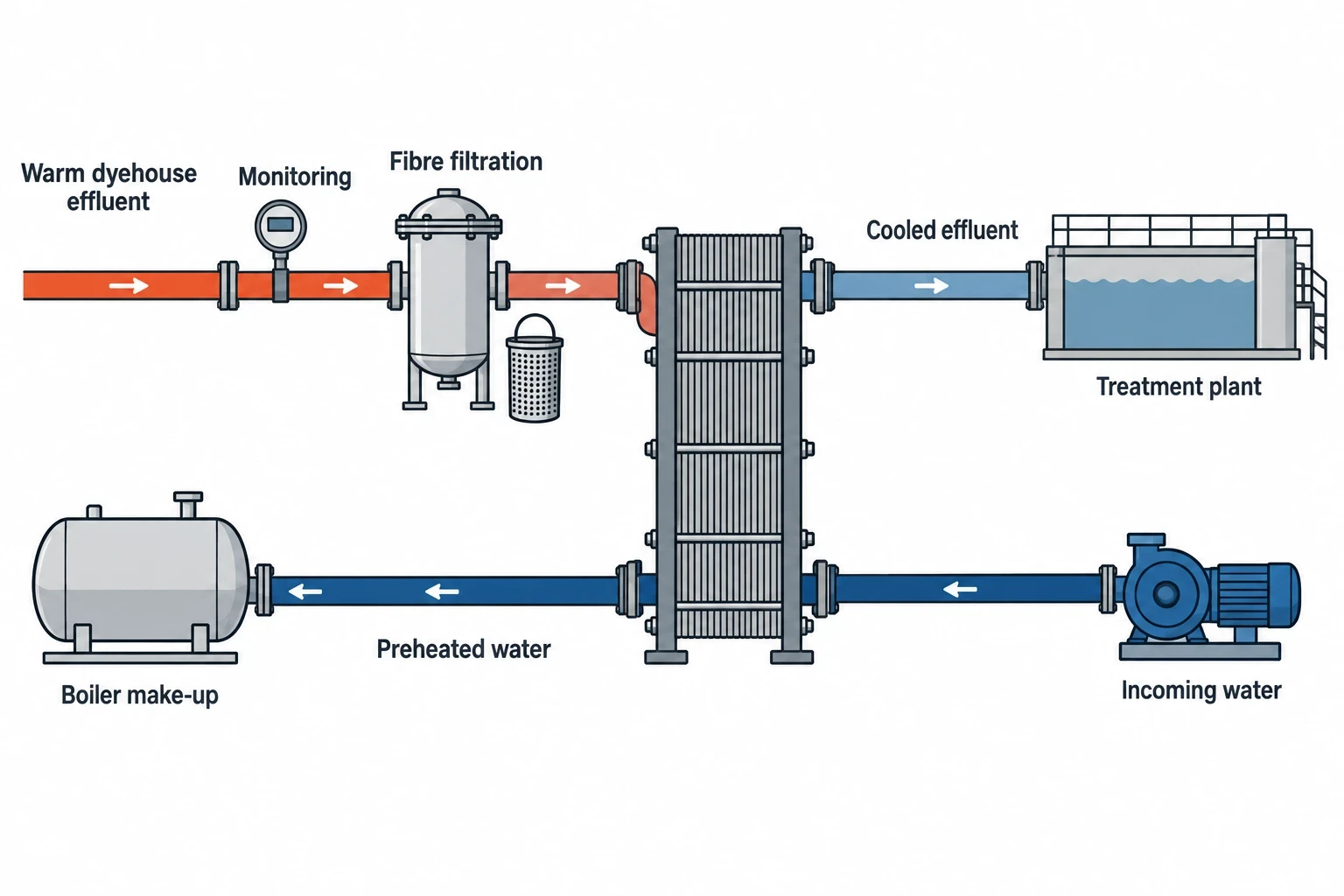
Warm effluent can represent one of the largest discarded energy streams in a dye house. Before using it for recovery, a plant should measure flow, temperature profile, solids, pH, conductivity and contamination risk over representative production periods.
Effluent heat recovery commonly transfers heat through an exchanger to incoming fresh water, boiler make-up water or a suitable low-temperature process loop. Filtration, accessible cleaning arrangements and fouling allowances matter as much as exchanger duty. A heat exchanger that rapidly blocks with fibres, oils or scale will not sustain its design performance.
Effluent temperature reduction can also assist downstream treatment processes. The receiving treatment plant still needs enough process control to manage biological performance, chemical treatment and sludge handling.
Use ZDHC wastewater guidance as an operational benchmark
ZDHC Wastewater Guidelines Version 2.2, published in September 2024, provide harmonised wastewater and sludge parameters, limits and test methods for textile, apparel and footwear supply chains. The guidance includes pass-or-fail criteria for hazardous chemicals covered by the ZDHC Manufacturing Restricted Substances List.
The guidelines go beyond a basic discharge-consent approach. They encourage sites to understand both conventional parameters and hazardous-chemical risks in wastewater and sludge. This makes them useful for mills working with brand customers that require consistent reporting across multiple suppliers.
ZDHC conformance does not replace legal obligations, discharge consents or permit conditions. A UK site needs to meet the requirements set by its regulator and water company while using industry guidance to strengthen chemical control and data quality.
A sound monitoring programme should include sampling locations before and after key treatment stages, documented sample handling, a defined laboratory schedule and investigation rules for abnormal results. One composite sample cannot explain a problem caused by a particular batch, shift or chemical delivery. Linking effluent data to production records makes root-cause analysis faster.

Identify where your plant is losing energy and quantify the savings potential — our audits map every heat source, sink, and waste stream in your facility.
Fibre Choice and Genuine Textile-to-Textile Circularity
Recycled polyester claims need careful scrutiny
Textile Exchange’s Materials Market Report 2025 found that global fibre production reached 132 million tonnes in 2024, up from around 125 million tonnes in 2023. Polyester represented 59% of global fibre output, and 88% of polyester was fossil-based.
The report also illustrates why material claims need precision. Recycled polyester accounted for roughly 9.3 million tonnes of production in 2024, but 98% was made from plastic bottles. Less than 1% of global fibre production came from pre-consumer or post-consumer recycled textiles.
Bottle-based recycled PET can reduce demand for virgin polymer in a textile supply chain, but it is not textile-to-textile circularity. A mill, converter or garment processor should state the feedstock clearly in customer documents and product claims.
Build traceability into production control
Sustainable textile manufacturing practices need traceability from incoming fibre through to finished product and waste route. This means keeping distinct records for:
- Virgin fibre
- Bottle-based recycled polyester
- Pre-consumer textile production waste
- Post-consumer textile-derived feedstock
- Offcuts and fibre waste returned to an internal process
- Waste dispatched for sorting, recycling, energy recovery or disposal
Segregation matters. Mixed-fibre waste, contaminated offcuts and poorly identified stock can limit recycling options before the material reaches a recycler. Production planning can reduce this loss by grouping compatible orders, managing colour changes and identifying clean offcuts at the point of generation.
Measuring Sustainable Textile Manufacturing Performance
Select indicators that reflect production conditions
Absolute consumption figures remain useful for financial control, but they do not show whether a site is becoming more efficient. Mills need normalised indicators alongside total consumption.
| Performance indicator | Suitable unit | Useful management question |
|---|---|---|
| Thermal energy intensity | kWh per kg of conditioned dry textile | Is heat use falling after adjusting for product mix? |
| Electricity intensity | kWh per kg of product | Are motors, extraction and auxiliary systems operating efficiently? |
| Water intake intensity | m³ per tonne of textile processed | Is lower-liquor-ratio processing reducing fresh-water demand? |
| Effluent intensity | m³ per tonne of textile processed | Is reuse reducing both intake and discharge? |
| Condensate return rate | Percentage of available clean condensate returned | Is recoverable boiler energy being lost? |
| Rework rate | Percentage of production batches or metres | Are quality losses eroding resource savings? |
| Stenter gas intensity | kWh per kg of water evaporated or textile processed | Are drying settings matched to actual moisture removal? |
ISO 50001:2018 provides a framework for managing energy performance. ISO 50006:2023 gives guidance on energy performance indicators and baselines. Together, they support a management system that connects process changes with measurable energy results rather than relying on annual consumption comparisons.
Verify savings after implementation
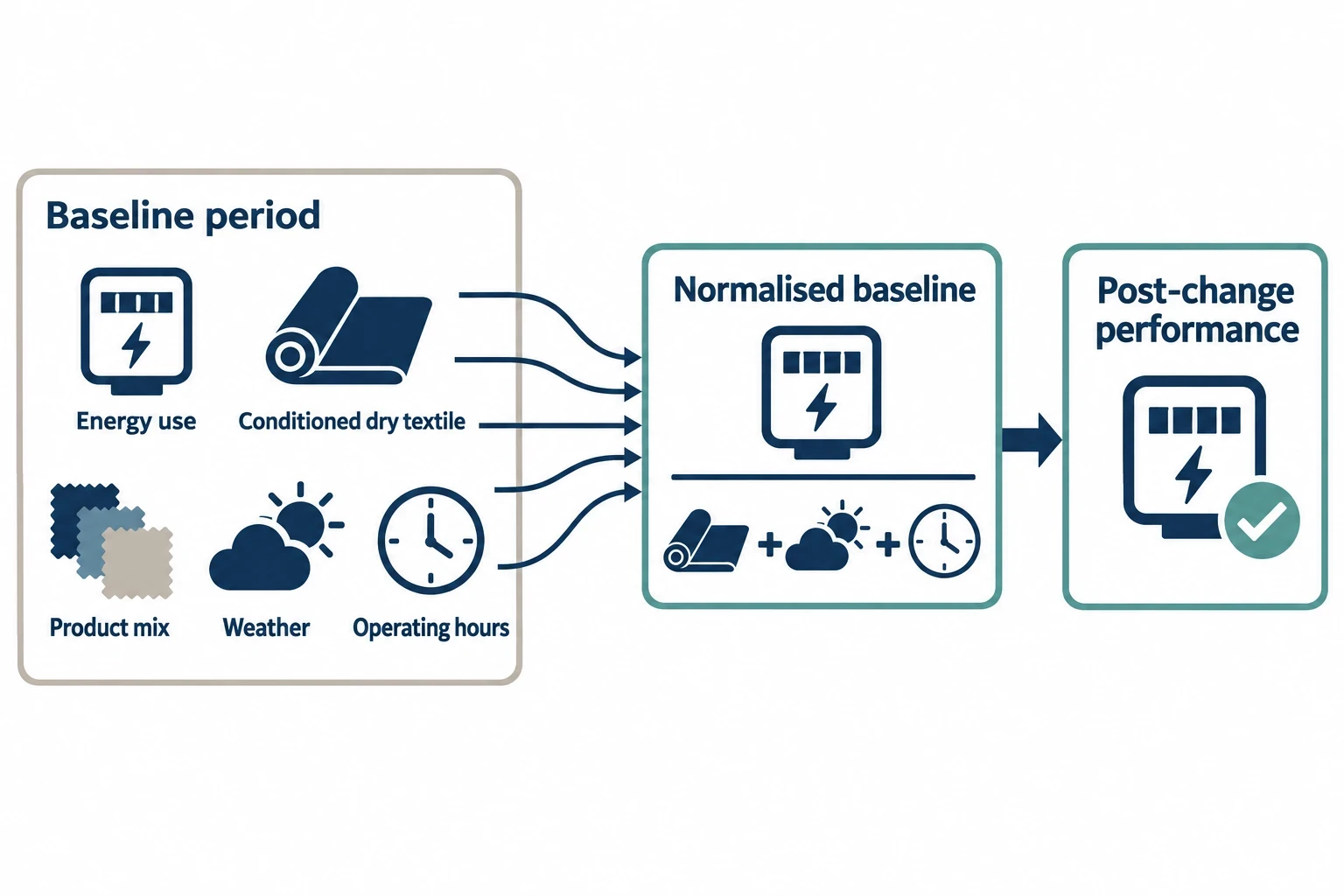
Measurement and verification should begin before equipment is changed. The baseline period needs enough production data to account for differences in weather, operating hours, product mix and throughput.
IPMVP provides established approaches for determining savings from energy conservation measures. For textile sites, the selected approach should match the intervention. A fan-control project may be measured at equipment level, while a dye-house optimisation programme may need a whole-facility model that adjusts for tonnes processed, batch type and operating temperature.
EnerTherm Engineering states that its textile audit programmes achieve an average 20% energy-cost reduction with a 1.8-year payback period. Individual projects require site-specific assessment because steam demand, machine age, fabric mix, available waste heat and production schedules vary between mills.
A Practical Capital Plan for Textile Mills Above 10t/day
The strongest projects sequence operational improvements before major capital works.
-
Establish a production-adjusted baseline for gas, electricity, water, steam, condensate and effluent.
-
Repair avoidable losses such as steam leaks, failed traps, compressed-air leaks, missing insulation and poorly controlled exhaust air.
-
Optimise existing dyeing, washing, drying and stenter set-points against measured quality results.
-
Identify heat-recovery opportunities using representative flow and temperature data, not nameplate assumptions.
-
Improve chemical inventory, dosing accuracy, wastewater segregation and effluent monitoring.
-
Prepare capital projects with a clear heat source, heat sink, operating-hours profile, maintenance requirement and measurement plan.
-
Verify results after implementation and retain the revised operating standard for future shifts and product changes.
This article reflects the independent analysis and editorial opinion of EnerTherm Engineering. Product names, trademarks, and brands mentioned belong to their respective owners. EnerTherm Engineering is not affiliated with, endorsed by, or a licensee of any third-party software or product mentioned unless explicitly stated.

Technical Manager — EnerTherm Engineering
John Naranjo is Technical Manager at EnerTherm Engineering, bringing specialist expertise in chemical and environmental engineering. He recently led the implementation of Omni Vision, EnerTherm's real-time energy and utility monitoring platform. He holds an MSc in Environmental Engineering from the University of Huelva and a BSc in Chemical Engineering, with memberships in both the Energy Institute and IChemE.
