Why Thread-Break Sensors Cut Textile Spinning Energy
EU BAT 36 links machine stoppage and humidity control to lower electricity use
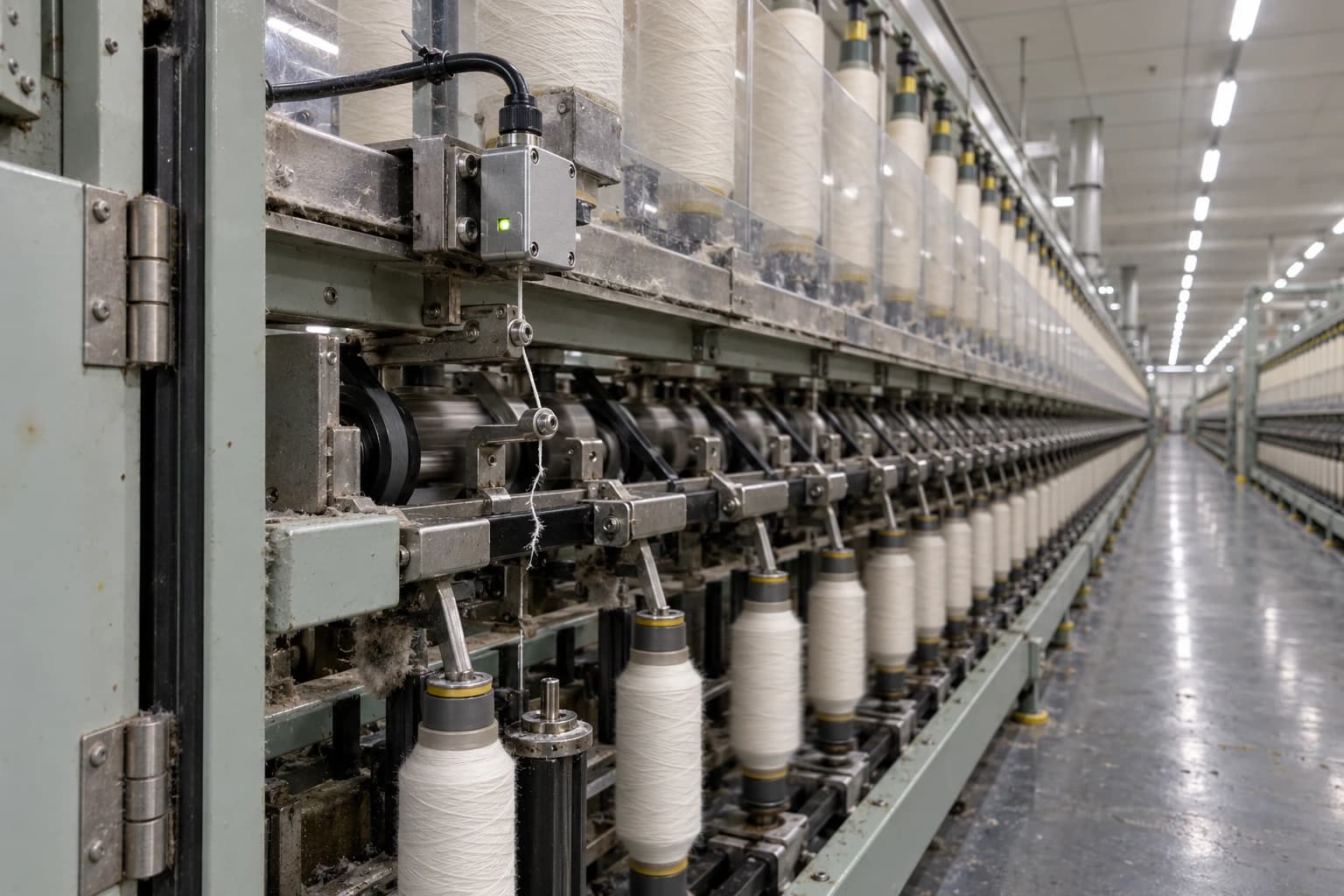
A thread-break sensor detects loss of a moving yarn or thread and signals the spinning or weaving machine to stop or isolate the affected operation.
That intervention addresses a persistent source of waste in textile production: machinery consuming electricity, compressed air and conditioned air after productive yarn formation or fabric insertion has ceased. A ring frame, winding machine or loom can continue to rotate, draw air or run auxiliaries after a break. The mill pays for energy while producing off-specification material, waste packages or no saleable output.
For UK mills seeking energy savings in textile spinning and weaving, thread-break sensing is more than a quality-control feature. It is a process-control measure that ties equipment energy use to production. The European Commission’s BAT 36 for spinning and weaving identifies advanced sensors that detect thread breaks and stop the machine as a generally applicable energy-saving technique.
Gains vary with machine type, break frequency, stopping logic, operating hours and the mill’s energy profile. They should be measured rather than assumed. Energy consumed during a thread break has no productive output to justify it, and better detection reduces those unproductive minutes.
Why a Thread Break Creates an Energy Penalty
Machines can consume energy without making yarn or cloth
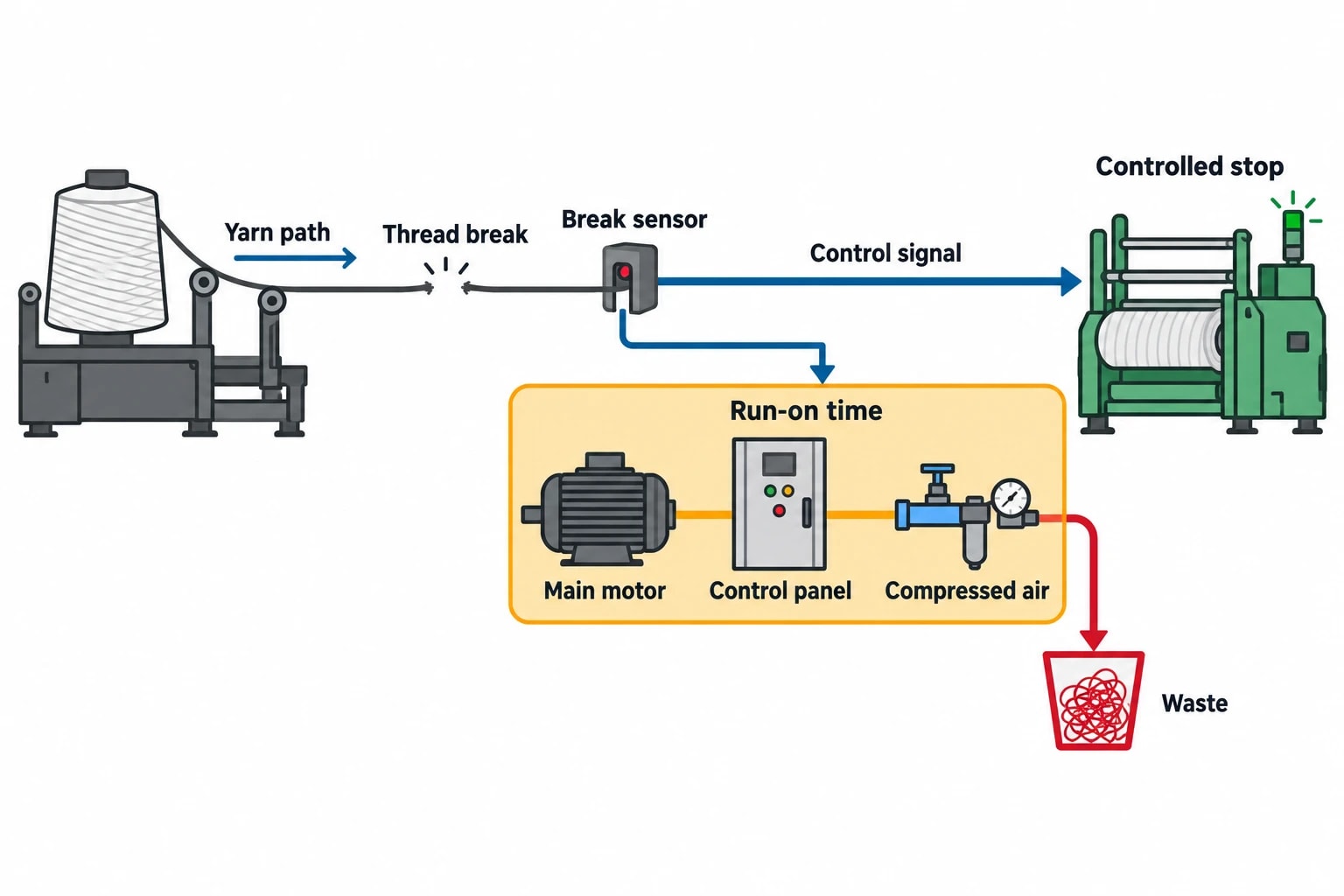
A yarn break removes the material connection that makes the process productive. The effects differ across a mill.
On a spinning line, a break can leave a spindle, winding position or related drive running while the yarn path has failed. In weaving, a warp or weft break can interrupt insertion and fabric formation after the loom and its auxiliaries have already consumed energy. The response depends on the machine architecture and installed controls.
The energy penalty has several layers:
- Main motors continue to consume electricity during run-on time.
- Drives, control panels and auxiliaries remain energised.
- Air-jet weaving may continue to demand compressed air until the stop sequence takes effect.
- Friction, movement and motors add heat to the production area.
- Operators spend time tracing breaks, clearing waste and restarting machines.
- Off-specification yarn or fabric may require reworking or scrapping, adding embodied energy to the loss.
The first three are direct electricity or compressed-air loads. The latter two affect the energy intensity of the finished product. A mill producing fewer kilograms of conforming yarn from the same electrical input records poorer kWh per kg performance, even where the utility meter shows no obvious change.
The value is in eliminating unproductive run time
Thread-break sensors do not reduce the energy required to twist fibre into yarn or insert a pick during normal operation. They reduce energy consumed when that work no longer produces saleable output.
This distinction matters during an energy audit. A machine may show a stable power trace while production quality deteriorates. Plant-level kWh can look acceptable against historic totals, yet energy per kg of accepted yarn rises as breaks, stoppages and waste increase. Metering must therefore be read alongside production, waste and downtime records.
A sensor shortens the delay between process failure and machine response. The longer a machine runs after a break, the greater the avoidable loss. The stop action must protect quality and mechanical integrity. Depending on the machine, this may mean stopping a position, isolating a section or bringing the machine to a controlled halt.
Identify where your plant is losing energy and quantify the savings potential — our audits map every heat source, sink, and waste stream in your facility.
BAT 36 Makes Thread-Break Detection an Energy Measure
What the European textiles BAT conclusions say
Commission Implementing Decision (EU) 2022/2508 sets out Best Available Techniques, known as BAT, for the textiles industry under the Industrial Emissions Directive 2010/75/EU. BAT 36 addresses energy efficiency in spinning and weaving.
It includes general energy-saving techniques such as reducing the conditioned production-area volume to reduce humidification demand, and using advanced sensors that detect thread breaks to stop spinning or weaving machines. BAT 36 also lists measures relevant to a sensor project:
- Lighter spindles and bobbins in ring frames.
- Spindle oil with appropriate viscosity.
- Appropriate yarn oiling.
- Ring diameter optimisation in relation to yarn diameter.
- Gradual start-up of ring spinning machines.
- Optimised empty-bobbin conveyor movement in cone winding.
- Avoidance of excessive air pressure in air-jet weaving.
- Double-width looms for suitable large-volume batches.
BAT 36 treats thread-break sensing as part of process optimisation rather than an isolated maintenance upgrade. The sensor performs best where the mill also controls air pressure, drive operation, machine start-up and ambient conditions.
A useful reference, even where UK permits differ
The European Commission’s 2023 Textiles Industry BREF provides the technical context behind the BAT conclusions. It covers fibre preparation, pre-treatment, dyeing, printing and finishing, while also describing upstream operations that can affect subsequent wet processing.
For a UK spinning or weaving mill, the BREF and BAT conclusions provide a structured engineering reference. They do not replace site-specific environmental permit requirements, machinery instructions, guarding assessments or electrical safety procedures. They offer a disciplined way to assess whether machinery continues to consume energy after production has ceased.
How Thread-Break Sensors Support Energy Saving in Textile Spinning and Weaving
Spinning: stopping wasted spindle and winding energy
In spinning, energy performance depends on output, running time and the condition of high-speed machinery. A break can compromise all three.
The first audit question is operational: how does the machine respond today? Some lines may stop a local position. Others may need a wider stop to avoid winding faults, yarn damage or safety concerns. The opportunity lies in the time between break occurrence and effective stopping, plus the time required to restore stable production.
Engineers should establish:
- Which stages experience the most breaks, such as ring spinning, winding or roving.
- Whether operators detect breaks visually, through machine alarms or through automated sensing.
- How long equipment runs after a break.
- Which drives and auxiliaries remain active during the event.
- How restart affects yarn quality, ends-down rate and output.
The sensor project should preserve the yarn-quality settings required by the product. A threshold set too aggressively can create nuisance stops, while a poorly positioned detector can miss intermittent failures. The aim is dependable identification of genuine thread loss followed by the correct controlled response.
Weaving: protecting loom uptime and compressed-air demand
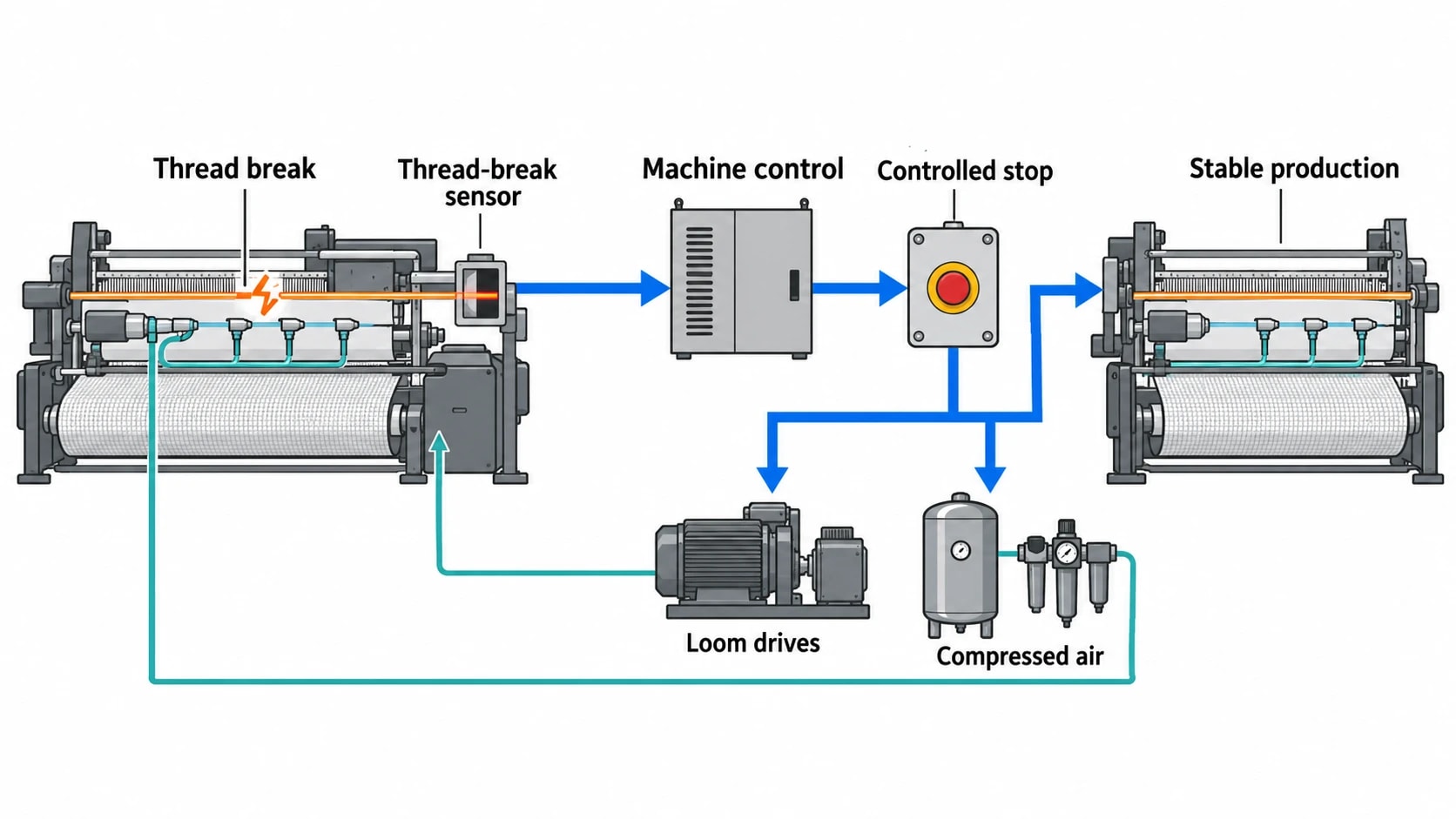
The energy case can be stronger in air-jet weaving because compressed air is a substantial utility load. BAT 36 identifies avoiding excessive air pressure in air-jet weaving as an energy-saving technique.
Thread-break sensing and air-pressure control should be considered together. A loom that recognises a break quickly avoids unnecessary continuation of an unproductive cycle. The mill should also confirm that air pressure matches the process requirement rather than a historic setpoint intended to compensate for poor maintenance, leaking hoses or variable yarn conditions.
The audit should distinguish between:
- Electrical consumption of loom drives and auxiliaries.
- Compressed-air generation at the compressor station.
- Air pressure and flow at the loom.
- Break-related stop time.
- Rejected fabric, rework and loom availability.
Reducing a nominal compressor setpoint without checking loom performance can create false economies. The mill should test any change against fabric quality, insertion reliability and loom stops. Pressure reduction requires stable process conditions, verified instrumentation and sound distribution piping.
Humidity control cannot be ignored
Textile production areas often require controlled ambient conditions to support fibre behaviour and product quality. Humidification and air movement can therefore account for a material share of site electricity use. BAT 36 includes reducing conditioned production-area volume, for example through a suspended ceiling, to reduce the energy required to humidify ambient air.
Thread-break sensors do not automatically reduce humidification demand. They reduce energy wasted by machinery operating without output. The mill can then examine whether the controlled zone exceeds production requirements, whether idle areas remain conditioned, and whether humidity control follows operating schedules.
This requires care. Altering humidity can change yarn behaviour, electrostatic effects and break frequency. A lower energy bill that destabilises production is not a practical energy saving. The control target must reflect fibre type, yarn specification, machine-maker requirements and observed quality performance.

Identify where your plant is losing energy and quantify the savings potential — our audits map every heat source, sink, and waste stream in your facility.
Measuring the Opportunity Before and After Installation
Establish a credible baseline
An energy audit should establish a baseline that captures normal variation in product mix, shift pattern and ambient conditions. Comparing one week before a retrofit with one week after can mislead where counts, yarn types, machine speeds or production hours have changed.
Useful baseline data includes:
| Measure | Why it matters |
|---|---|
| kWh per kg of accepted yarn or fabric | Connects electricity use to saleable output |
| Thread breaks per machine-hour | Identifies the scale and location of the problem |
| Mean time from break to stop | Quantifies unproductive run-on time |
| Machine availability | Shows whether control changes affect output |
| Waste and rework rate | Captures energy embedded in non-conforming product |
| Compressed-air electricity and pressure | Essential for air-jet weaving assessments |
| Humidity and temperature trends | Helps separate process effects from HVAC demand |
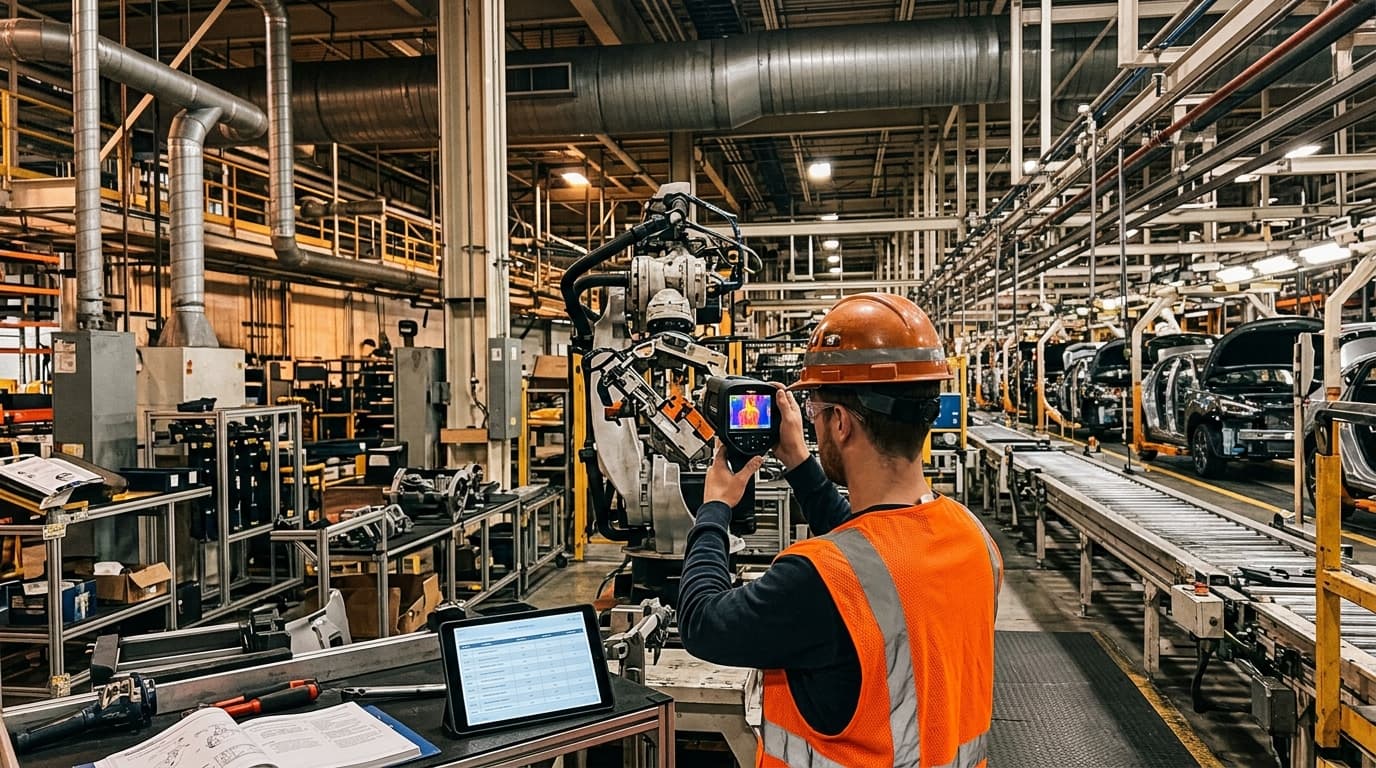
Portable power analysers can capture the electrical signature of a machine during normal running, break detection, controlled stopping and restart. Ultrasonic leak detection supports the compressed-air review. Thermal imaging can identify overheated motors, bearings, electrical connections or poorly insulated services that contribute to avoidable losses.
The analysis should separate base load from break-related load. A loom or ring frame has background electrical demand whenever energised. The sensor opportunity lies in avoidable operating time and yield loss caused by delayed detection.
Use measurement and verification that operations teams trust
Measurement and verification should continue after commissioning. International Performance Measurement and Verification Protocol methods provide a structured framework, but the practical requirement is simple: compare energy and production on a like-for-like basis, document adjustments and retain the underlying records.
A verification plan should record the following before and after the intervention:
- Production quantity and accepted output.
- Product type and operating speed.
- Scheduled production hours and unplanned stops.
- Energy-meter readings at the relevant machine or line.
- Compressed-air operating conditions where applicable.
- Break frequency, response time and operator interventions.
- Quality results and waste.
The review should also check for nuisance alarms, sensor contamination, damaged wiring, altered yarn paths and overridden stop functions. A sensor bypassed to maintain output offers no reliable energy benefit and may conceal a process issue.
A Practical Audit Route for Textile Mills
Start with the production loss, not the sensor catalogue
The project should begin where the mill sees repeat breaks, persistent waste or unexplained energy intensity. Operations records, quality reports and operator knowledge usually identify candidate machines quickly.
The next step is to establish whether thread-break detection is absent, unreliable, slow, poorly integrated with machine controls or routinely overridden. Machine-maker documentation and a competent controls review should determine the feasible stop sequence. Changes to safeguarding, interlocks or electrical systems require appropriate engineering control.
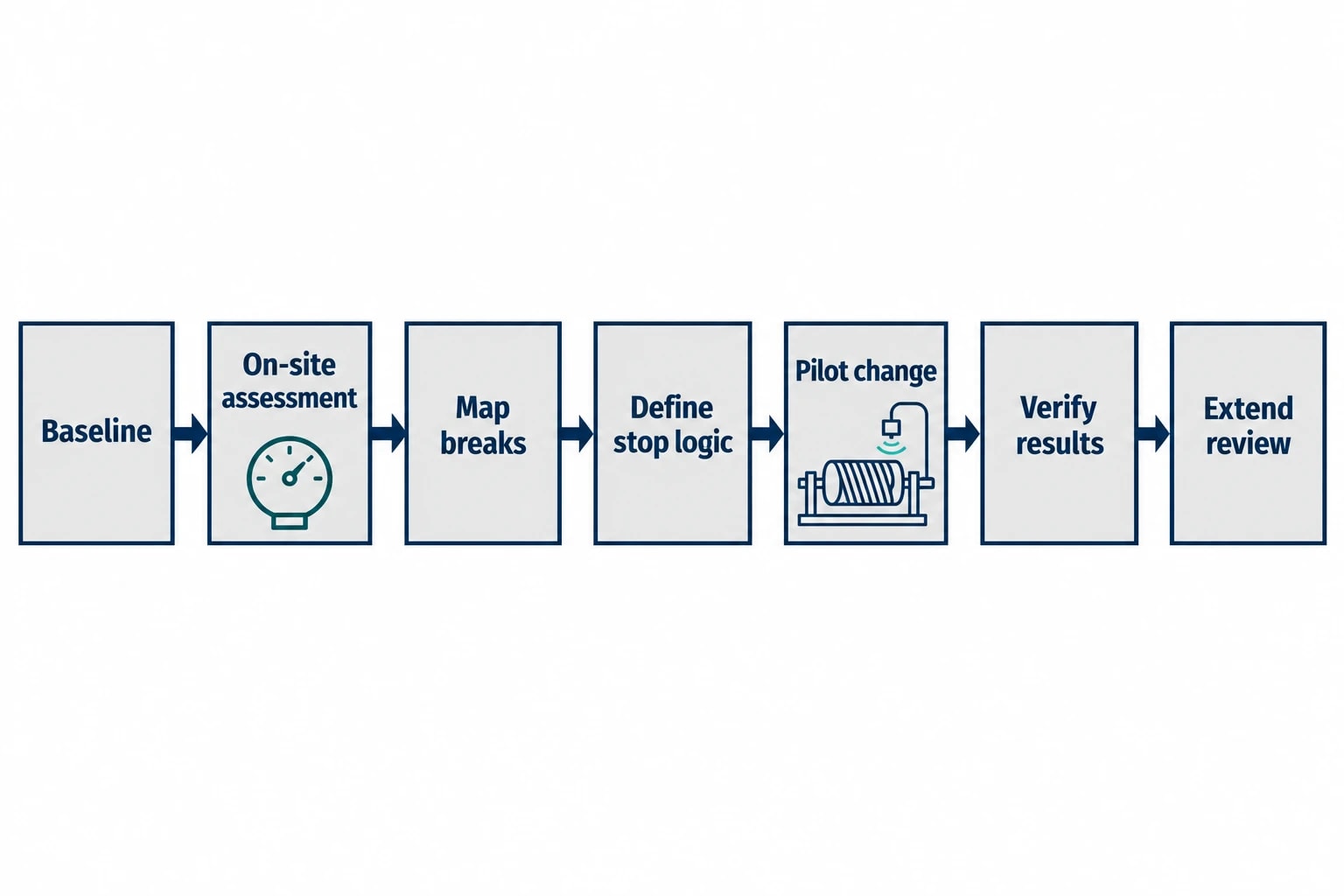
The following staged approach limits disruption:
- Establish an energy and production baseline for candidate lines.
- Conduct an on-site assessment during normal production, including power, compressed-air and ambient-condition measurements.
- Map breaks, response times, waste and restart behaviour by machine and shift.
- Define the required detection and stop logic with operations, maintenance and quality teams.
- Pilot the change on a representative machine or section.
- Verify yarn quality, fabric quality, availability and energy intensity.
- Extend the intervention where measured results support it, then continue periodic review.
This approach fits a wider industrial energy audit. Thread-break sensing may provide a quick operational measure, while the same audit can identify air leaks, excessive air pressure, inefficient drives, poor HVAC zoning and heat losses in adjacent dyeing or finishing operations.
Connect the project to ESOS Phase 4 reporting
Large UK undertakings within the Energy Savings Opportunity Scheme should include industrial-process energy in their assessment. For ESOS Phase 4, significant energy consumption must cover at least 95% of total organisational energy consumption. Organisations must also calculate energy-intensity ratios for buildings, transport, industrial processes and other energy use.
The qualification date is 31 December 2026, and the deadline for a Phase 4 notification of compliance is 5 December 2027. The 2026 amendments also require reporting of progress against action-plan commitments and an explanation where proposed measures were not implemented.
A thread-break sensor project can form an industrial-process measure supported by evidence where the mill records the baseline, implementation cost, estimated and verified energy saving, production effect and measurement method. It should not be reported as a flat saving percentage without supporting metering and output data.
The Commercial Case Depends on Production Discipline
Thread-break sensors save energy by reducing unproductive machine operation. Their wider value lies in reducing waste, shortening fault response and improving the energy-intensity data available to plant managers.
The strongest projects pair reliable detection with appropriate stop logic, routine sensor checks, stable humidity conditions, sound compressed-air management and metering normalised to production. This provides a measurable route to lower kWh per kg without sacrificing yarn quality, loom uptime or operator confidence.
This article reflects the independent analysis and editorial opinion of EnerTherm Engineering. Product names, trademarks, and brands mentioned belong to their respective owners. EnerTherm Engineering is not affiliated with, endorsed by, or a licensee of any third-party software or product mentioned unless explicitly stated.

Managing Director — EnerTherm Engineering
Dr. François Pierrel is Managing Director of EnerTherm Engineering with over two decades of expertise in thermal design, heat transfer, and industrial energy optimisation. He holds a PhD in Heat Transfer from Cranfield University and a Post-Doctorate from Heriot-Watt University.
