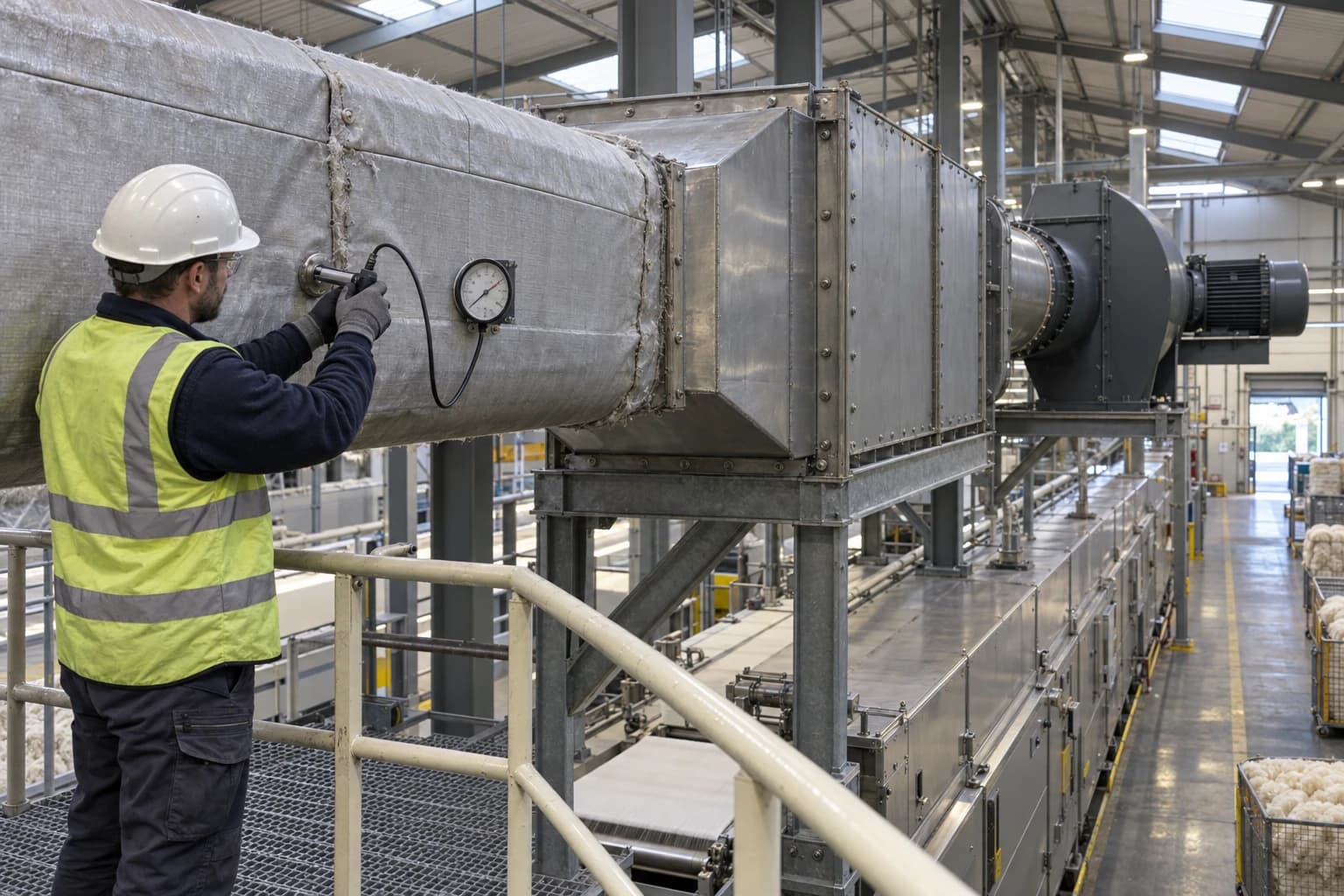
Why Textile Mills Start Waste Heat Recovery with Stenters
EU textile BAT guidance identifies stenter exhaust for air preheating or hot water.
Waste heat recovery in textile manufacturing captures usable thermal energy from process exhaust, hot water or combustion gases and transfers it to a lower-temperature textile load. In a wool-stenter study by Buket Cinar Gelir and Havva Ceylan, a heat exchanger reduced natural-gas use from 205.3 m³/h to 177.3 m³/h, a 13.6% reduction, at a drying-air inlet temperature of 180°C.
That result is specific to one machine and operating condition. It still illustrates why stenters lead the project list. They discharge heat through a defined exhaust route, run for production-driven periods and often sit near heat loads that can accept recovered energy. The engineering task is to match that source to a sink with sufficient demand at the right temperature, without disturbing fabric quality, drying performance or emissions control.
The 2022 Journal of Cleaner Production paper by Miriam Benedetti, Lorena Giordano and Marcello Salvio examined thermal use at 354 textile plants. It identified 70 heat-recovery projects across 13 measure types and mapped the main sources and sinks. Textile mills hold several recovery opportunities, but the source with the clearest route, repeatable duty and short connection usually makes the most practical first scheme.
Why Stenter Exhaust Leads Waste Heat Recovery in Textile Manufacturing
A stenter dries, cures or heat-sets fabric while controlling width and tension. Large circulating-air volumes transfer heat to the moving web. A controlled proportion leaves as exhaust, carrying water vapour, sensible heat and contaminants released from the fabric and finish.
The exhaust duct creates a measurable project boundary. Engineers can measure temperature, airflow, static pressure and operating hours without inferring heat from a mixed drain network. A stenter also gives the audit a clear fuel connection: gas, steam or thermal-oil demand rises and falls with line speed, fabric moisture, set temperature and exhaust settings.
A quantified recovery opportunity
The Cinar Gelir and Ceylan study reported a fuel reduction at a defined operating point rather than an abstract theoretical saving. The temperature, moisture content, exhaust flow, fresh-air requirement and fabric programme govern the useful duty available from an individual stenter.
An audit should record:
- Exhaust temperature, airflow and static pressure by chamber or exhaust zone
- Stenter fuel input and electrical demand for circulation and extraction fans
- Fabric width, speed, mass per unit area and wet pick-up
- Drying, curing or heat-setting temperatures
- Fabric exit moisture and quality requirements
- Recipe, finish chemistry and product mix
- Running, idling, cleaning and changeover hours
These measurements establish whether the exhaust stream has sufficient stable duty during normal production. A recovery proposal based on a short high-load trial can overstate annual savings if the stenter frequently processes lighter fabric, idles between lots or runs with changed exhaust settings.
Nearby heat demand improves the business case
Recovered heat has value only while a receiving process can use it. Stenters commonly have two nearby sinks.
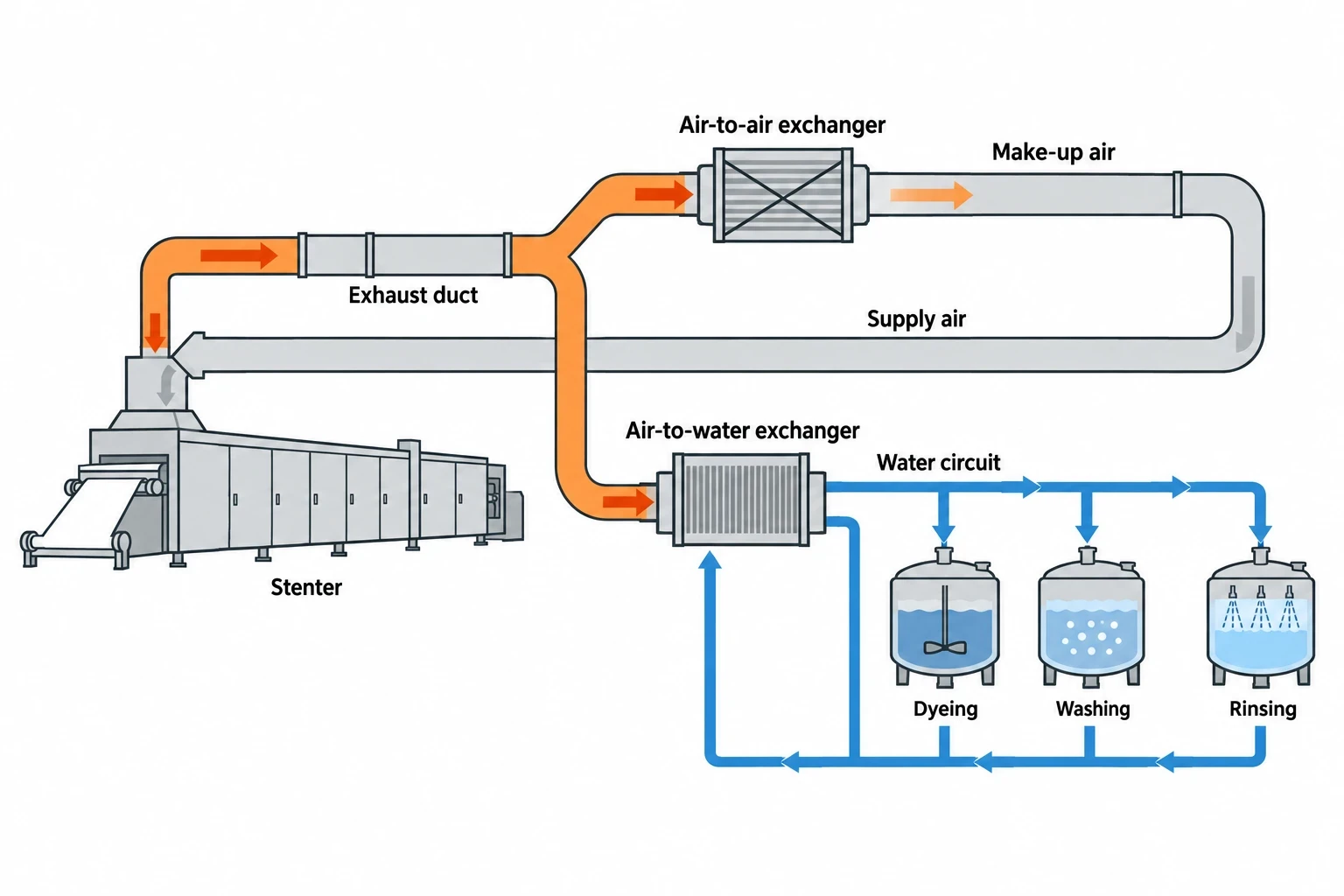
The first is fresh make-up air for the same stenter. Exhaust heat preheats incoming air before the burner or heating system raises it to the required supply condition. The energy path is short and the thermal demand follows stenter operation.
The second is water for wet processing. Dyeing, washing and rinsing can require substantial quantities of warm or hot water. An air-to-water exchanger can transfer heat from stenter exhaust into a controlled water circuit, reducing heat otherwise supplied by steam, gas or thermal oil.
The European Commission’s 2023 Textiles Industry BREF identifies both air-to-air heat exchange for stenter supply air and air-to-water heat exchange for process or heating water. It also identifies equivalent recovery from waste-gas-treatment exhaust. The BREF supports a disciplined source-to-sink comparison rather than a one-size-fits-all equipment choice.
Identify where your plant is losing energy and quantify the savings potential — our audits map every heat source, sink, and waste stream in your facility.
How Stenter Heat Recovery Systems Use the Exhaust Stream
The choice between air preheat and hot-water generation turns on temperature, timing, contamination and the sink’s operating profile. Both systems use indirect heat transfer: the exhaust and recovered medium remain separated by a heat-transfer surface.
Air-to-air heat recovery for stenter make-up air
An air-to-air exchanger transfers sensible heat from stenter exhaust to incoming fresh air. The preheated air then enters the stenter’s make-up-air path, reducing burner duty.
This arrangement suits stenters with regular operation and a high fresh-air requirement. It avoids a water circuit, buffer vessel and distribution pipework. It also keeps recovered energy at the source, reducing the risk that a downstream process will be unavailable when the heat arrives.
The principal design checks are:
- Exhaust-side and fresh-air-side pressure drop
- Fan capacity and electrical penalty
- Leakage between exhaust and supply-air paths
- Access for cleaning heat-transfer surfaces
- Bypass operation during cleaning, failure or low-load running
- Stenter control response as inlet-air conditions change
Extra fan power belongs in the saving calculation. A large exchanger with restrictive ducting may increase gas savings while eroding the net energy benefit through electrical consumption.
Air-to-water recovery for dye-house and washing loads
An air-to-water system transfers heat into a water circuit serving washing, dye preparation, rinsing or another defined lower-temperature process load. It can suit mills that run stenters and wet processing at the same time.
Hot-water recovery needs a detailed demand study. Water use varies by batch, recipe and production schedule. A buffer vessel can bridge short gaps between heat generation and heat demand, but introduces heat losses, footprint, pump energy and temperature-control requirements.
The receiving process must have a defined minimum and maximum delivery temperature. Hot water that is too cool may offer little displacement of boiler energy. Water that is too hot can interfere with recipe control, wash performance or safety arrangements. The system should use suitable control valves, temperature sensors and a bypass route that protects the stenter when water demand falls.
Cascaded use requires a genuine temperature match
Some mills can use exhaust heat in stages. A higher-temperature section can preheat make-up air, while remaining heat supports lower-temperature water production. The arrangement requires close review of heat-exchanger area, pressure drop, fouling allowance and simultaneous demand.
Direct air preheat often deserves assessment first because the stenter is the immediate, predictable sink. A second recovery stage is justified where measured water demand persists after the direct opportunity has been assessed.
Fouling and Exhaust Treatment Govern Long-Term Performance
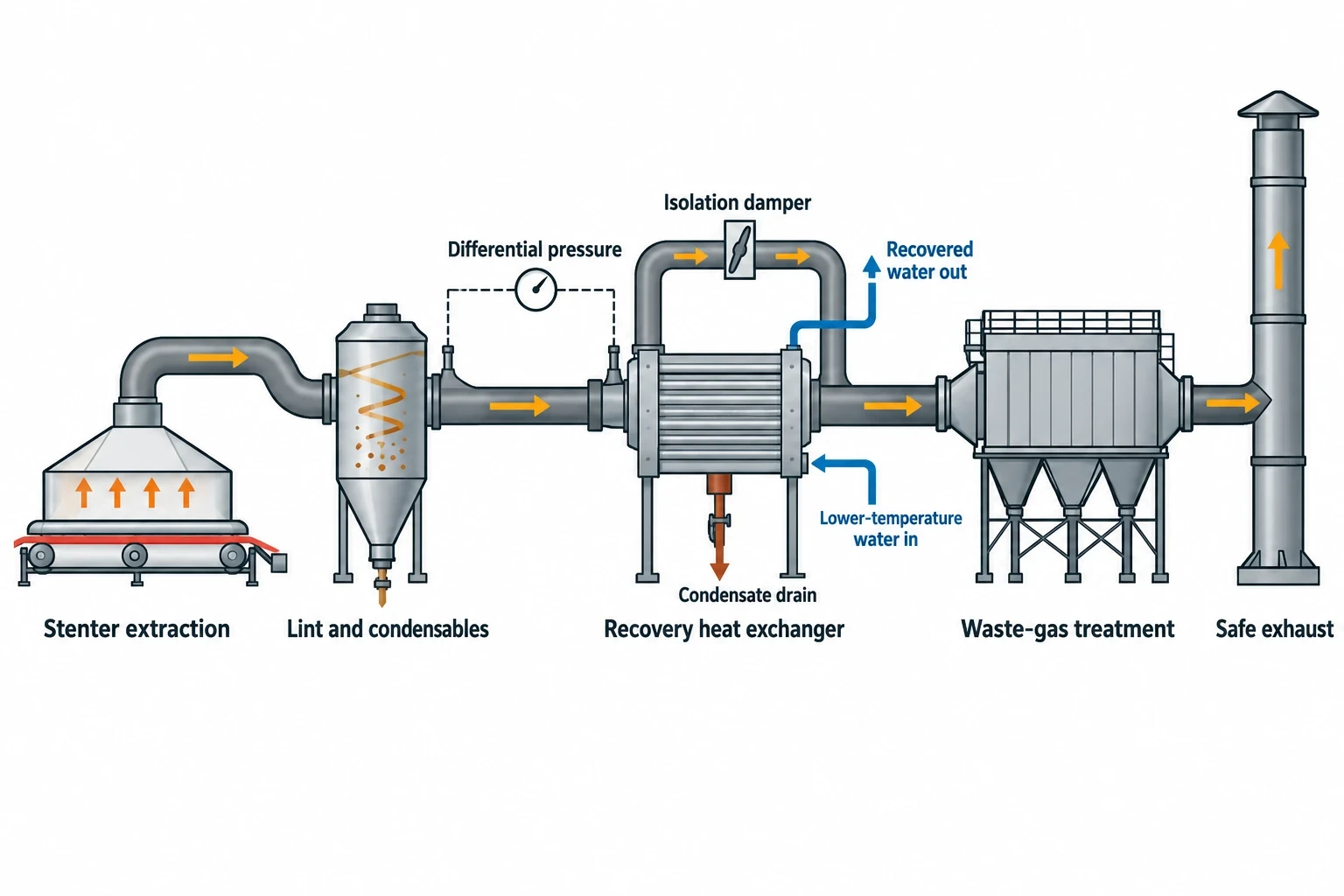
Stenter exhaust is process gas, not clean ventilation air. Its composition changes with fibres, finishes, coating systems, softeners, oils, binders and drying conditions. Lint and condensable material can coat a heat-transfer surface, reducing heat transfer and raising pressure drop.
A project can meet its commissioning target and then lose output if cleaning, drainage and access are treated as secondary details.
Characterise fabric and finish chemistry before equipment selection
The survey should map the fabric types and chemical recipes passing through each stenter. Polyester heat-setting, heavily softened fabric, coated textiles and water-repellent finishing can present different fouling and emissions characteristics.
This information guides exchanger geometry, material selection, pre-separation equipment and cleaning frequency. It also informs whether the heat exchanger should sit before or after an existing waste-gas-treatment stage.
A mill should assess the exhaust-treatment sequence as one system. Moving a heat exchanger upstream or downstream changes gas temperature, contamination loading and maintenance access. It may also alter the operating conditions of filtration, electrostatic precipitation, thermal treatment or other permitted abatement equipment.
Maintain the required exhaust balance
The stenter requires extraction to remove moisture and process vapours. Recovery equipment must not compromise drying consistency, odour control, condensation management or fabric finish.
Differential-pressure instruments across the exchanger and filters give operators early warning of fouling. Controls should preserve the required exhaust flow across the production programme rather than rely on fixed manual damper positions. The commissioning plan should test more than one fabric and finish type.
Cleaning provisions should include safe isolation, inspection access, condensate collection, compatible cleaning chemicals and reinstatement checks. Following maintenance, the team should confirm airflow, pressure drop, recovered-air or recovered-water temperature, burner response and fabric quality.
Treat condensate and fire protection as design items
Cooling contaminated exhaust can create condensate. The design needs suitable drainage, collection and disposal arrangements that account for oils, chemicals and suspended material. Poor drainage can lead to corrosion, odour and carry-over.
Where the exhaust stream and equipment configuration create a fire risk, the design should incorporate the site’s fire strategy, isolation arrangements and temperature monitoring. Controls must return the stenter to a safe operating mode if the recovery unit trips or requires cleaning.

Identify where your plant is losing energy and quantify the savings potential — our audits map every heat source, sink, and waste stream in your facility.
A Textile Energy Audit Must Match Sources to Sinks
A hot exhaust duct does not automatically produce fuel savings. Useful heat duty depends on source temperature, airflow, fouling condition, recovery temperature and the receiving load’s timing.
The Benedetti, Giordano and Salvio research treats textile recovery as a set of source-to-sink decisions. Stenter exhaust, hot effluent, steam condensate and boiler flue gas can each be useful. Their temperatures, contamination risks and operating patterns determine the order in which a mill should pursue them.
Establish a production-adjusted baseline
A credible baseline relates energy use to operating conditions. Comparing one monthly gas bill with another can confuse recovery savings with production volume, weather, fabric mix or recipe changes.
For a stenter, the baseline should account for fabric mass, wet pick-up, line speed, set temperature, dwell time, fibre type, finish type and production hours. Ambient temperature can affect fresh-air heating demand. Water demand and inlet-water temperature also matter for an air-to-water system.
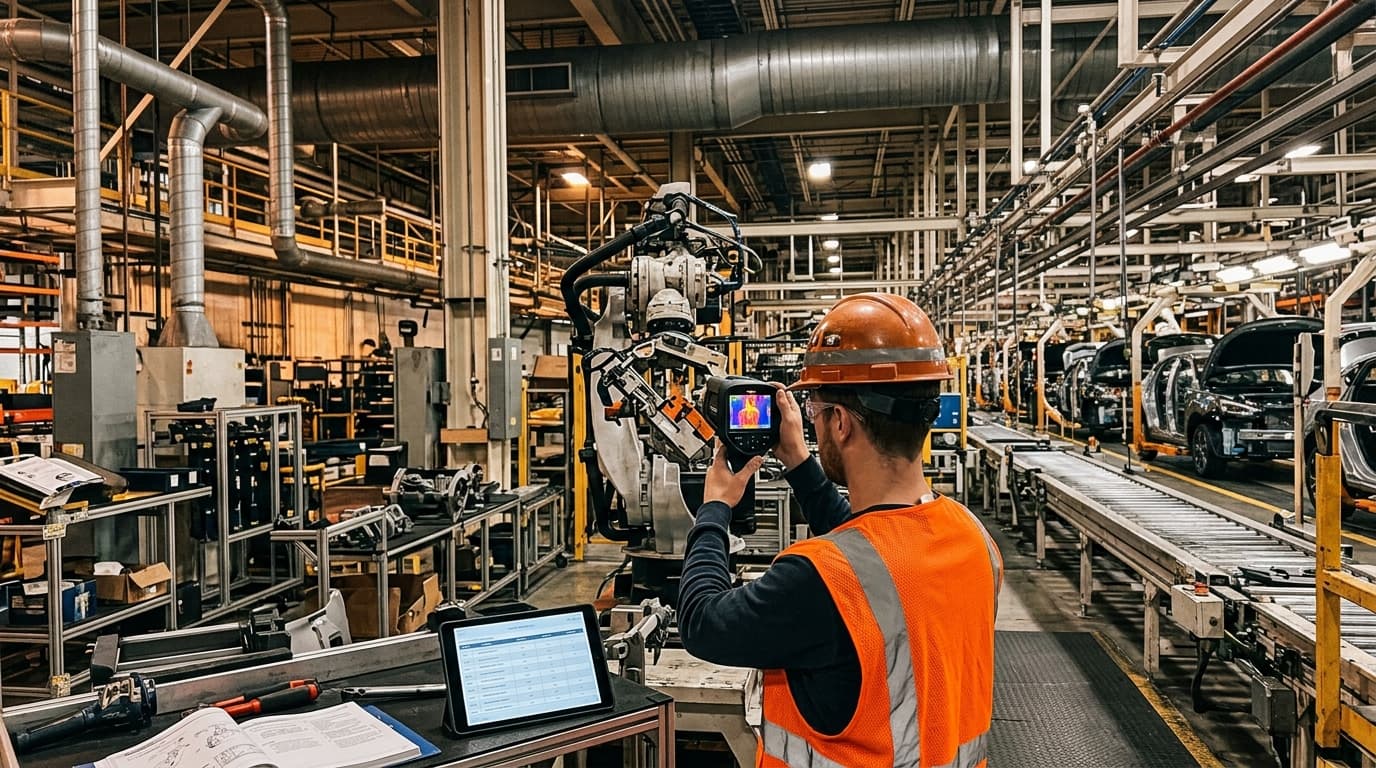
Portable measurement supports the initial assessment. Priority instruments include exhaust temperature probes, airflow and pressure measurement, fuel sub-metering, electrical measurement for fans and pumps, and water-flow and temperature measurement where water recovery is proposed.
Rank opportunities by usable duty
A source-and-sink register prevents a familiar error: selecting a heat exchanger around the hottest visible source while leaving the receiving load undefined.
| Waste-heat source | Likely first heat sink | Main engineering constraint |
|---|---|---|
| Stenter exhaust | Stenter make-up air | Fouling, pressure drop and exhaust balance |
| Stenter exhaust | Wash or dye-house water | Coincident water demand and storage losses |
| Hot wash effluent | Incoming wash water | Fibres, chemistry and variable batch discharge |
| Steam condensate | Boiler feedwater or process water | Flash steam, contamination and return pressure |
| Boiler flue gas | Boiler feedwater | Corrosion risk and boiler operating limits |
The register should also include distance, operating hours, required temperature, available temperature, water quality, maintenance access and outage requirements. A lower-temperature source close to a continuous sink can outperform a hotter source that needs long pipe runs or substantial storage.
Define the project boundary before procurement
The saving calculation must include the full system boundary: stenter fuel displaced, fan power, pump power, heat loss from pipework or storage, cleaning energy and any additional water-treatment demand. This produces a net-energy view rather than a gross exchanger-duty figure.
A practical first scheme has accessible duct connections, sufficient space, a bypass arrangement and an installation route that fits a planned shutdown. Pre-fabrication can reduce the site outage, but final tie-in work still requires agreement with production and maintenance teams.
Textile BAT and UK Permit Considerations
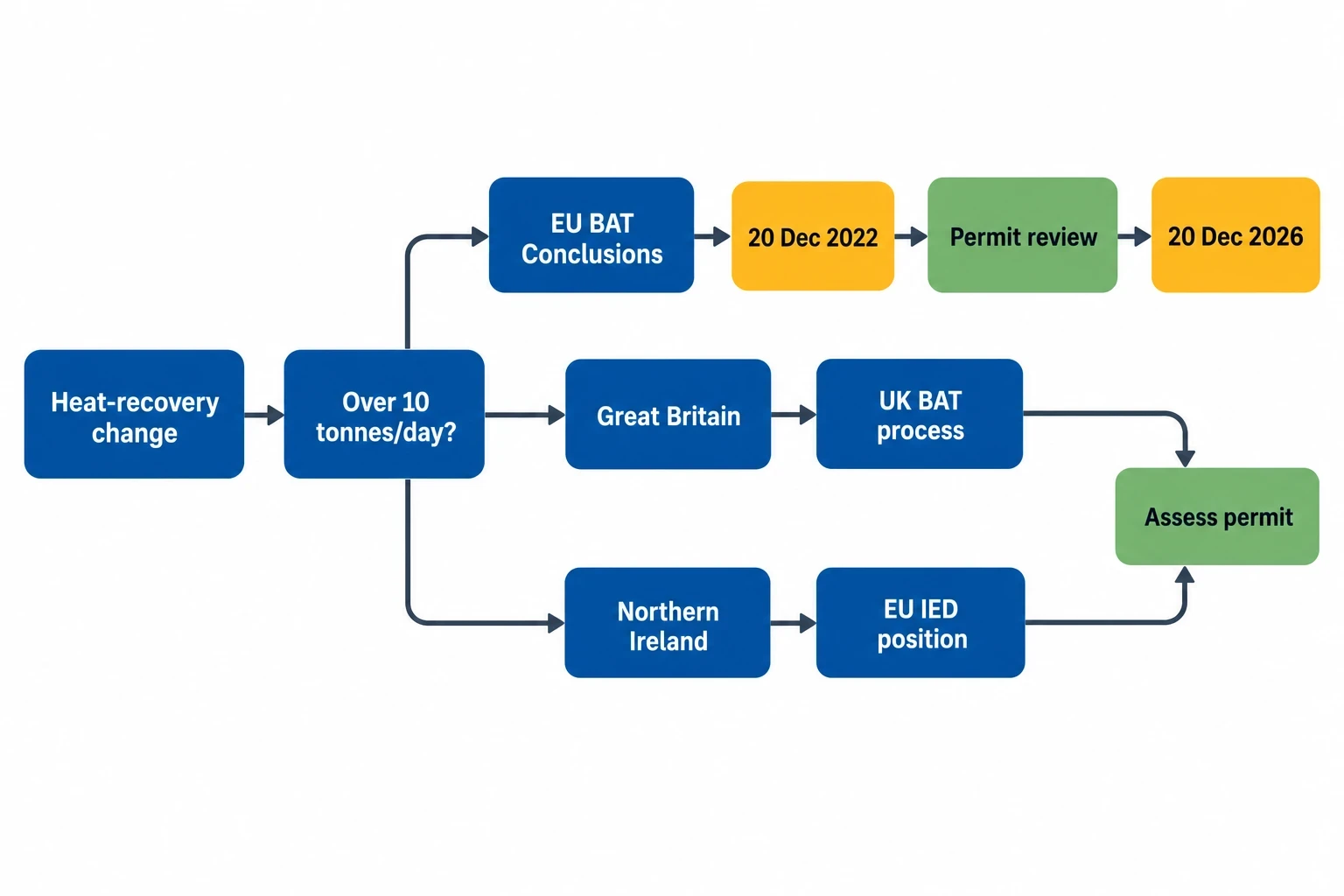
The 2023 EU Textiles Industry BREF provides the technical reference. Commission Implementing Decision (EU) 2022/2508 of 9 December 2022 contains the Textile Industry BAT Conclusions under Directive 2010/75/EU on industrial emissions.
The EU textile BAT deadline falls in December 2026
The Decision covers pre-treatment or dyeing of textile fibres or textiles above 10 tonnes per day, along with directly associated activities. Its scope includes on-site combustion used for direct or indirect heating, drying and heat-setting when associated with the covered activity.
The Decision was published on 20 December 2022. Under Article 21(3) of Directive 2010/75/EU, the competent authority must reconsider and, where necessary, update permit conditions within four years of publication of a BAT Conclusions decision. For affected EU installations, 20 December 2026 is therefore a significant compliance date.
Heat recovery is not a substitute for emissions control. It forms part of a resource-efficiency assessment that must preserve the performance of the permitted exhaust system.
UK mills should work from their permit conditions
Great Britain operates its own BAT process. UK government guidance states that new EU BAT Conclusions do not automatically apply in Great Britain, while Northern Ireland remains subject to the EU Industrial Emissions Directive position for sectors covered by the Northern Ireland arrangements.
For a UK textile mill, the environmental permit and relevant regulator determine the legal requirements. A heat-recovery change that alters ductwork, waste-gas treatment or emissions characteristics should be assessed early with the permitting position in mind. The engineering file should document the existing exhaust route, treatment equipment, expected temperatures, bypass mode and operating controls.
Measurement and Verification Keep Savings from Drifting
A stenter recovery system can lose performance through fouling, altered recipes, changed exhaust setpoints, lower water demand or added fan and pump electricity. Measurement and verification turns those changes into operating information.
Use an IPMVP-aligned measurement plan
IPMVP Core Concepts 2022 provides a recognised framework for measuring and verifying energy and water-efficiency projects. Its central principle is practical: savings are determined by comparing measured consumption before and after an intervention, with adjustments for changed conditions.
For a stenter project, a retrofit-isolation boundary often works well. It can include stenter fuel, recovery-unit electricity, exhaust conditions and recovered heat. The reporting plan should state the baseline period, meters, calculation method, production variables, routine adjustments and treatment of material changes such as a new fabric range or altered finishing chemistry.
Track operating indicators alongside fuel use
Monthly gas consumption is useful, but it rarely explains why performance changed. Energy managers should also review:
- Recovered-air or recovered-water outlet temperature
- Temperature difference across the exchanger
- Exhaust-side pressure drop
- Fan and pump electrical use
- Cleaning frequency and duration
- Stenter gas use per tonne of finished fabric
- Fabric quality, throughput and drying performance
A falling recovered-water temperature may reflect lower exhaust temperature, lower airflow, a changed water-flow setpoint or fouled surfaces. Pressure-drop trends help distinguish fouling from a production change, allowing maintenance to act before lost recovery becomes a persistent fuel cost.
This article reflects the independent analysis and editorial opinion of EnerTherm Engineering. Product names, trademarks, and brands mentioned belong to their respective owners. EnerTherm Engineering is not affiliated with, endorsed by, or a licensee of any third-party software or product mentioned unless explicitly stated.

Managing Director — EnerTherm Engineering
Dr. François Pierrel is Managing Director of EnerTherm Engineering with over two decades of expertise in thermal design, heat transfer, and industrial energy optimisation. He holds a PhD in Heat Transfer from Cranfield University and a Post-Doctorate from Heriot-Watt University.
