Why Agricultural Grain Dryers Are Adopting Heat Recovery Units
How heat recirculation strategies cut fuel expenditure by 40% in large-scale facilities.
A conventional agricultural grain dryer wastes up to 40% of its thermal energy by venting heated exhaust directly into the atmosphere. In high-capacity continuous processing operations, this represents a severe and continuous financial drain. Rising propane and natural gas prices, compounded by stricter carbon emissions taxation, force agricultural business owners to reassess post-harvest thermal management. Capturing and reusing this wasted heat is no longer an optional upgrade; it is an economic baseline. This analysis examines the benefits of heat recovery in agricultural grain dryers, detailing the engineering principles, regulatory drivers, and financial returns that justify these capital investments for modern processing facilities.
The Financial Baseline of Grain Moisture Reduction
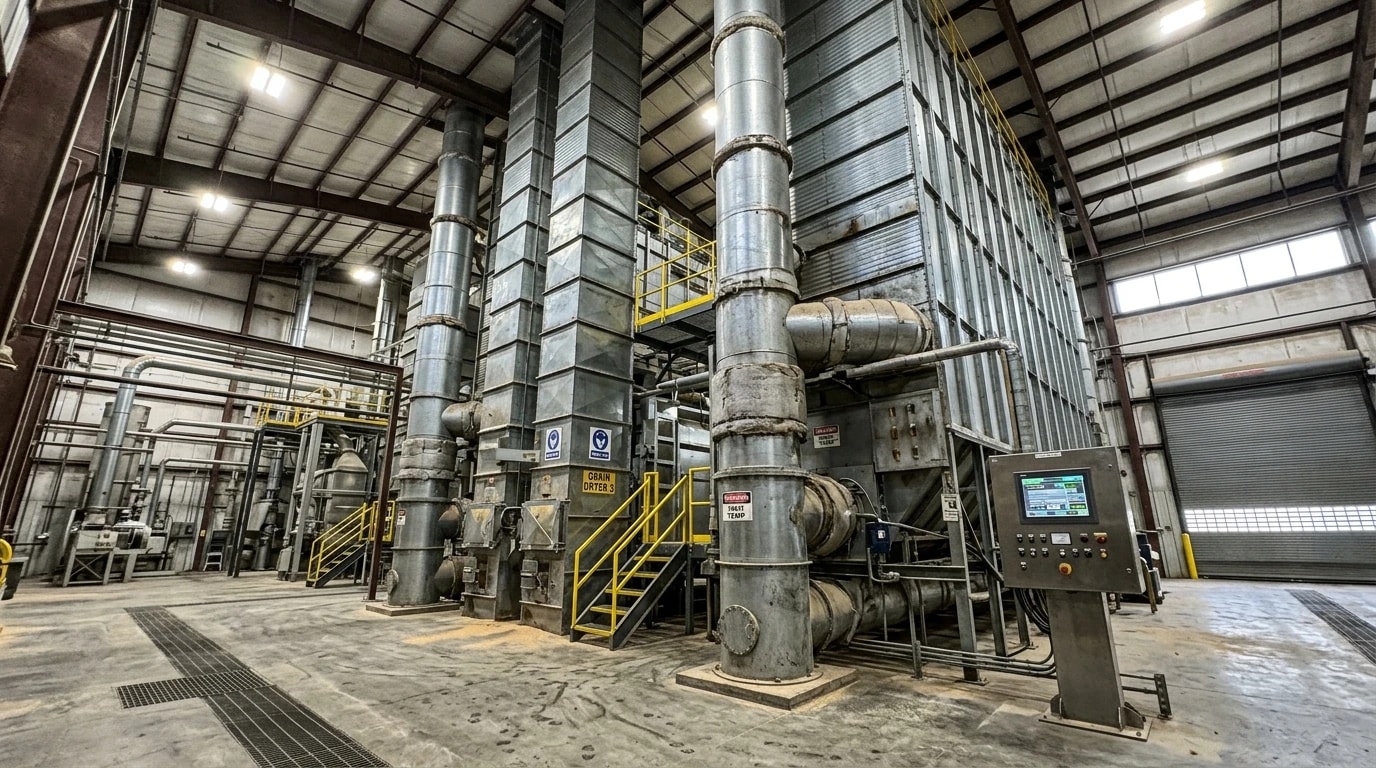
Removing moisture from harvested crops is an energy-intensive thermodynamic process. High-capacity operations must rapidly lower harvest moisture content to prevent spoilage, mycotoxin development, and dry matter loss. In a typical seasonal scenario, maize or wheat enters the facility at a harvest moisture of 20% to 25% and must be dried down to a safe storage threshold of 14% to 15%.
The energy required is dictated by the specific heat capacity of the crop and the latent heat of vaporisation of water. Because water requires approximately 2,260 kilojoules per kilogram (kJ/kg) to phase-change from liquid to vapour, drying thousands of tonnes of high-moisture crop is inherently fuel-heavy. Operators typically burn propane, natural gas, or light fuel oil to heat ambient intake air to drying temperatures exceeding 90°C.
Continuous-Flow Dryer Inefficiencies
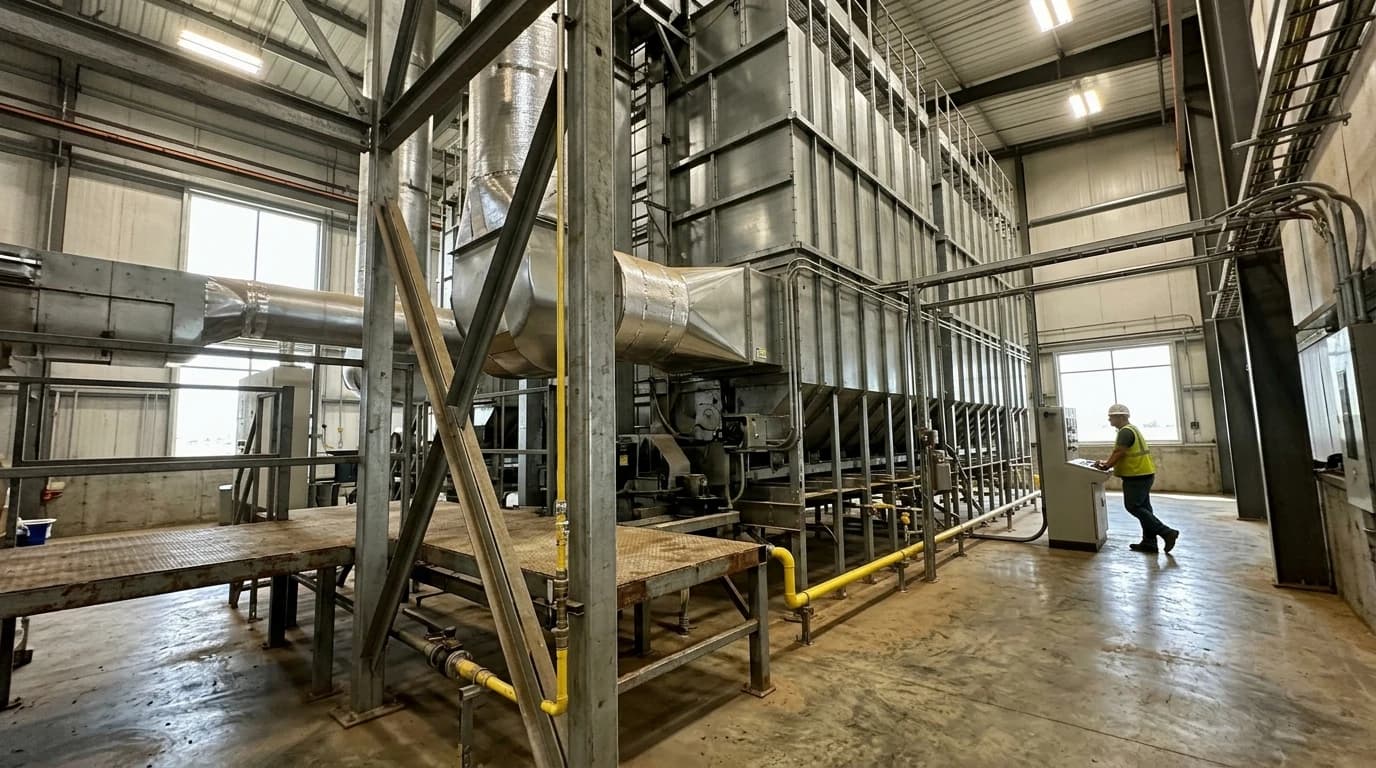
Most large-scale agricultural facilities utilise continuous cross-flow or mixed-flow dryers. These systems force heated air through moving columns of grain. As the air passes through the wet crop, it absorbs moisture and cools. However, the air exiting the lower cooling sections of the dryer often remains significantly warmer than the ambient environment, yet it is traditionally expelled as waste. Venting this warm, relatively dry air discards valuable thermal energy that the burner just consumed fuel to generate.
The Impact of Ambient Harvest Conditions
The exact efficiency loss depends on ambient harvest temperatures. When drying late-season crops in cold ambient conditions, the temperature delta between the outside air and the required plenum temperature is exceptionally wide. Every degree the burner must raise the intake air requires a proportional volume of fuel. Venting warm exhaust in near-freezing conditions exacerbates the financial penalty of conventional drying operations.
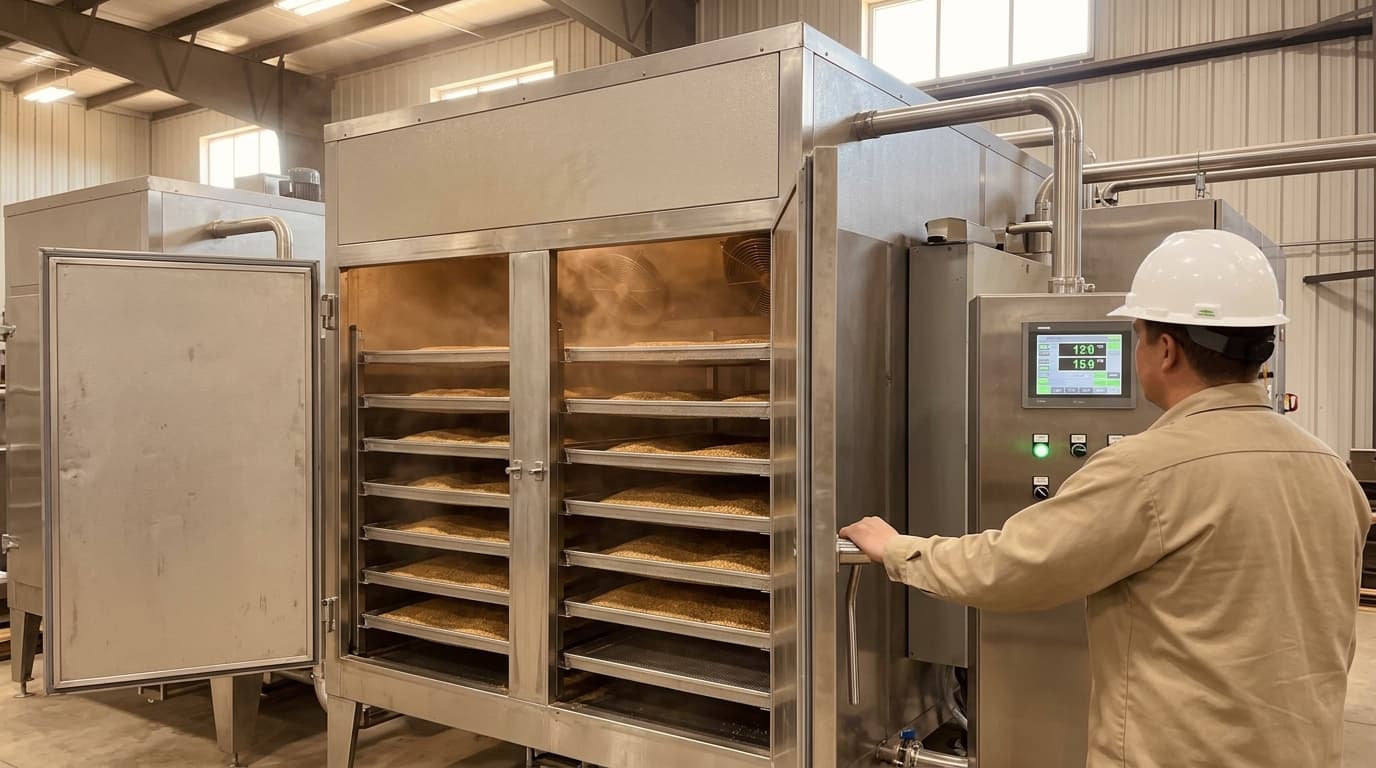
Industrial dehydration systems designed for precise moisture removal — from agricultural produce and pet food to chemical powders and pharmaceutical intermediates.
Engineering Mechanisms: How Heat Recovery Units Operate
Integrating a heat recovery system fundamentally alters the airflow architecture of a grain dryer. Instead of drawing 100% of its intake from the cold ambient atmosphere, the system captures a portion of the exhaust air and routes it back into the burner intake stream.
Air-to-Air Heat Exchangers
Process engineers often specify air-to-air heat exchangers to facilitate this energy transfer. These units allow the hot, moisture-laden exhaust air from the upper drying sections to pre-heat the incoming cold ambient air without mixing the airstreams. This separation prevents the reintroduction of saturated air into the drying plenum, ensuring that the intake air remains dry enough to effectively absorb moisture from the grain.
Direct Thermal Recirculation
Alternatively, operators can utilise direct thermal recirculation. This method captures the exhaust air exclusively from the lower cooling sections of the dryer. Because the grain in the cooling section is already dry, the air exiting this zone is warm but possesses a low relative humidity. Fans redirect this specific exhaust stream directly into the burner intake. Blending this warm air with ambient air reduces the thermal lift required from the burner. For example, if ambient air is 5°C and the recirculated air raises the mixed intake temperature to 25°C, the burner expends significantly less fuel to reach the final 90°C setpoint.
Suction Cooling and Vacuum Configurations
Beyond direct recirculation and heat exchangers, industrial design teams frequently deploy suction cooling configurations. In a suction cooling setup, the main blower fan is positioned downstream of the cooling section. The system pulls ambient air through the hot, dried grain at the bottom of the column. As the air passes through the grain bed, it simultaneously cools the crop and absorbs its sensible heat. This pre-heated air is then drawn directly into the burner housing. OMAFRA documentation verifies that suction cooling architectures capture enough waste heat to generate 15% to 20% energy savings on their own, serving as a highly effective baseline form of thermal recovery.
Cost Benefit Analysis of Heat Recovery Systems for Agricultural Grain Drying
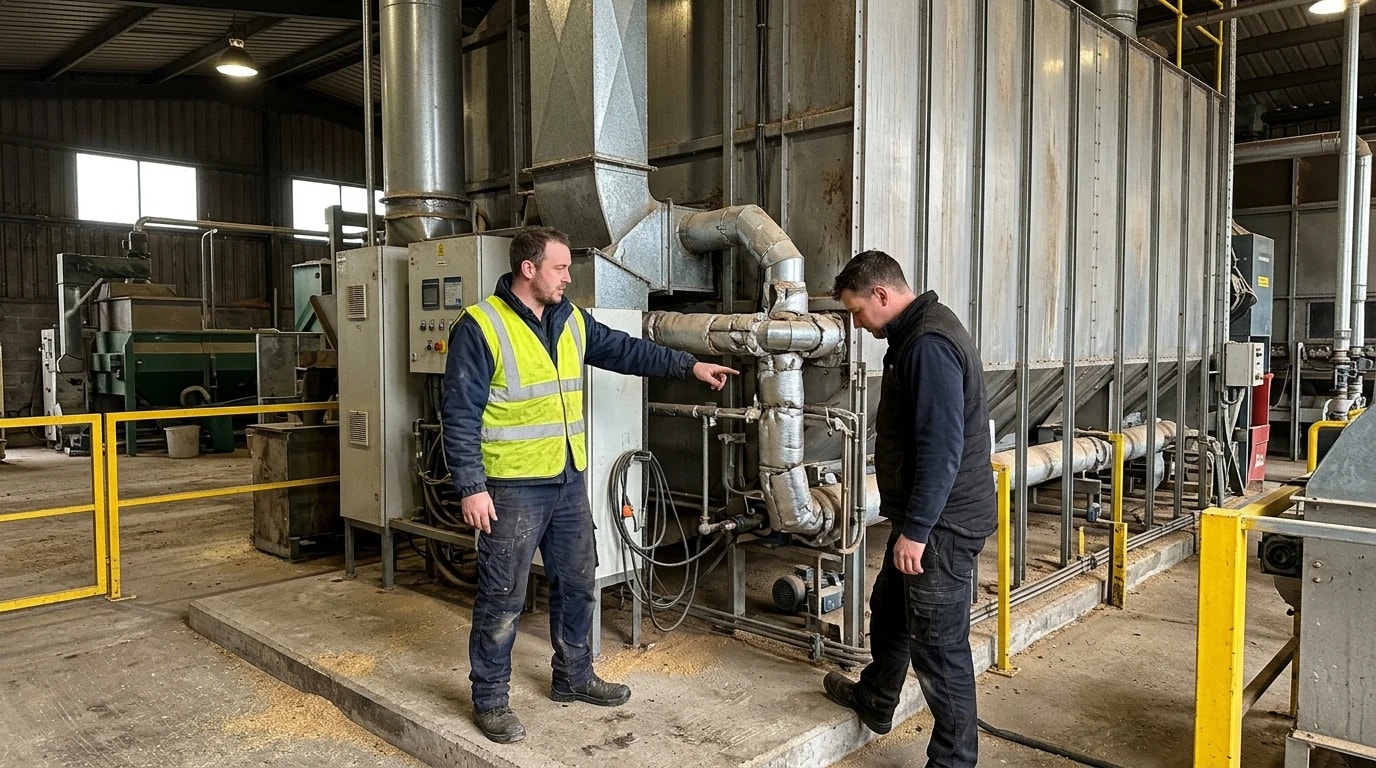
Facility engineers evaluate the viability of thermal upgrades through strict financial metrics. A formal cost benefit analysis of heat recovery systems for agricultural grain drying hinges on balancing the initial capital expenditure against the projected annual reduction in variable operational costs.
Validating Fuel Cost Reductions
Guidance published by the Ontario Ministry of Agriculture, Food and Rural Affairs (OMAFRA) establishes a definitive performance benchmark. Operators achieve a 20% to 40% fuel cost reduction by retrofitting heat recirculation and heat exchanger systems into continuous cross-flow dryers. Importantly, this reduction occurs without negatively affecting dryer throughput or grain quality.
For a facility drying 10,000 tonnes of grain annually, the baseline fuel expenditure is substantial. If the operation consumes 150,000 litres of propane per season, a median 30% efficiency gain from heat recovery eliminates the purchase of 45,000 litres of fuel. At volatile energy market prices, this directly translates into tens of thousands of pounds in retained capital per harvest.
Capital Expenditure (CAPEX) vs Operational Savings
The initial capital outlay includes the physical heat recovery hardware, additional ducting, modified fan arrays, and advanced sensor control systems. Retrofitting an existing dryer requires custom engineering to ensure aerodynamic balance, as altering intake pressures can disrupt the thermal uniformity within the drying columns.
Despite the upfront costs, the energy savings from heat recovery in grain drying systems accumulate rapidly. Agricultural business owners calculate the net present value (NPV) of these savings over the equipment's lifespan, which routinely exceeds 15 years for high-quality industrial thermal hardware.
Maintenance and Lifecycle Cost Considerations
A rigorous financial assessment must account for the ongoing maintenance of the installed technology. Heat pipe heat exchangers and passive ducting arrays introduce very few moving parts to the existing dryer architecture. Maintenance is typically restricted to routine clearing of particulate filters and annual inspection of the recirculation fan bearings. Because the heat recovery equipment requires no independent power input to transfer thermal energy, its isolated operational expenditure (OPEX) is practically zero.
Calculating the Payback Period
Industry standards dictate that thermal engineering upgrades must demonstrate rapid amortisation. Typical financial feasibility guidance suggests that if the capital expenditure of a heat recovery system can be amortised within 5 years, it yields long-term net operational savings.
| Financial Metric | Conventional Dryer | With Heat Recovery Unit |
|---|---|---|
| Annual Fuel Consumption | 150,000 Litres | 105,000 Litres (-30%) |
| Annual Fuel Cost (£0.60/L) | £90,000 | £63,000 |
| Annual Savings | £0 | £27,000 |
| Estimated CAPEX (Retrofit) | £0 | £95,000 |
| Projected Payback Period | N/A | 3.5 Years |
Once the payback period concludes, the £27,000 annual savings directly increases the facility's profit margin, protecting the operation from future fuel market price spikes.
The LitBurn, AgriBurn, AmoBurn, and AniBurn ranges cover every waste disposal need with dual-chamber combustion and scrubbing options.
Complementary Efficiency Strategies: Dryeration and In-Bin Cooling
While hardware upgrades deliver immediate financial returns, operations managers frequently pair heat recovery units with advanced grain handling protocols. Academic research published in the Transactions of the ASAE and extensive field data from university extension services, such as UW–Madison and Purdue University, quantify massive energy efficiency gains through specific cooling strategies. These methods improve dryer energy use by up to 30%.
The Mechanics of Dryeration
Dryeration is a process that transfers hot grain directly from the high-temperature dryer into a dedicated tempering bin before cooling begins. Instead of cooling the grain rapidly inside the primary dryer column—which consumes dryer time and energy—the grain is removed at 50°C to 60°C, with a moisture content 2% to 3% above the final target.
The hot grain steeps in the dryeration bin without airflow for 4 to 12 hours. This tempering period allows moisture trapped in the dense centre of the kernel to migrate to the outer edge.
Synergising Cooling Systems with Heat Recovery
Following the tempering phase, operators activate high-volume aeration fans to cool the grain. This slow cooling process removes the final fraction of moisture using only the residual heat stored within the grain itself.
Research indicates that dryeration leads to energy savings of 20% to 40% and increases primary dryer capacity by 50% to 75%. When combined with a heat recovery unit on the main dryer, the cumulative reduction in fossil fuel reliance is profound. The primary dryer runs continuously at peak thermal efficiency, supported by recycled exhaust heat, while the passive dryeration process handles the most difficult phase of moisture extraction.
In-Bin Cooling vs. Dryeration
While dryeration requires a dedicated tempering bin, in-storage cooling provides a streamlined alternative. In this method, grain is dried to within one or two percentage points of the final storage moisture inside the high-speed dryer. The hot grain is then moved directly to the final storage silo, bypassing the tempering phase entirely. High-capacity cooling fans activate immediately to cool the grain in place. While in-storage cooling lacks the full capacity-boosting power of a dedicated dryeration tempering phase, it still reduces the primary dryer's fuel consumption and eliminates an extra handling step.
UK and EU Regulatory Pressures and Financial Incentives
The adoption of heat recovery technology is not driven solely by internal financial modelling. External regulatory frameworks and government funding programmes heavily influence capital investment timelines across the agricultural sector.
Aligning with Net Zero 2050
The agricultural sector is under increasing pressure to align with national Net Zero 2050 mandates. Scope 1 emissions—direct greenhouse gas emissions from owned or controlled sources—are heavily concentrated in on-farm fuel combustion. Burning hundreds of thousands of litres of propane for grain drying creates a massive carbon footprint. Integrating heat recovery systems allows facilities to demonstrate a proactive reduction in their Scope 1 emissions, safeguarding their contracts with major food processors and supermarkets that demand low-carbon supply chains.
Emissions Compliance and Environmental Permitting
Throughout the UK and the European Union, industrial thermal processes face stringent emissions oversight. The EU Medium Combustion Plant Directive (MCPD) and corresponding UK Environmental Permitting (England and Wales) Regulations 2016 mandate strict limits on nitrogen oxides (NOₓ) and sulphur dioxide (SO₂). By recovering heat and reducing total fuel consumption by up to 40%, agricultural facilities proportionally lower their site-wide emissions profile. This reduction aids in compliance, reduces the administrative burden of emissions reporting, and minimises potential carbon taxation liabilities.
Defra’s Farming Equipment and Technology Fund (FETF) 2026
To accelerate the agricultural sector's transition to lower-carbon operations, government bodies provide targeted financial support. In the UK, the Department for Environment, Food and Rural Affairs (DEFRA) actively subsidises efficiency upgrades.
The latest round of the Farming Equipment and Technology Fund (FETF 2026) allocates £50 million to farmers and contractors, including £20 million specifically earmarked for farm productivity. Operations managers apply for grants to offset the initial capital expenditure of integrating advanced thermal control systems and energy efficiency hardware. Securing grant funding against the CAPEX of a heat recovery retrofit drastically shortens the payback period, shifting the financial calculation from a long-term strategic goal to an immediate operational priority.
Long-Term Feasibility for Agricultural Business Owners
The decision to install a heat recovery unit fundamentally upgrades the financial resilience of a grain processing facility. Operations that continue to vent 40% of their thermal energy into the atmosphere will face compounding disadvantages against competitors who optimise their thermodynamic cycles.
Optimising Process Throughput
The benefits of heat recovery in agricultural grain dryers extend beyond the fuel ledger. A stabilised intake temperature, pre-heated by recovered exhaust, allows the burner to maintain precise setpoints with less oscillation. This thermal stability translates to a more uniform moisture profile across the dried grain, reducing the incidence of over-dried or stress-cracked kernels. Consistent grain quality commands premium market prices and prevents costly dockage fees at the point of sale.
Strategic Asset Management
Facility engineers evaluate industrial thermal hardware based on lifecycle performance. A well-engineered heat recovery unit operates with minimal mechanical wear, relying primarily on passive heat exchangers or variable frequency drive (VFD) recirculation fans. Once integrated, the system operates quietly in the background, continuously stripping cost from every tonne of grain processed.
The cost-benefit data is unambiguous. With validated evidence confirming up to 40% fuel savings, and academic studies proving the supplementary benefits of dryeration, the thermal engineering data points to a singular conclusion. For operations processing high volumes of wet grain, capturing waste heat and recycling thermal energy ensures long-term profitability, secures regulatory compliance, and establishes a highly efficient baseline for modern agricultural production.
This article reflects the independent analysis and editorial opinion of EnerTherm Engineering. Product names, trademarks, and brands mentioned belong to their respective owners. EnerTherm Engineering is not affiliated with, endorsed by, or a licensee of any third-party software or product mentioned unless explicitly stated.

Managing Director — EnerTherm Engineering
Dr. François Pierrel is Managing Director of EnerTherm Engineering with over two decades of expertise in thermal design, heat transfer, and industrial energy optimisation. He holds a PhD in Heat Transfer from Cranfield University and a Post-Doctorate from Heriot-Watt University.
