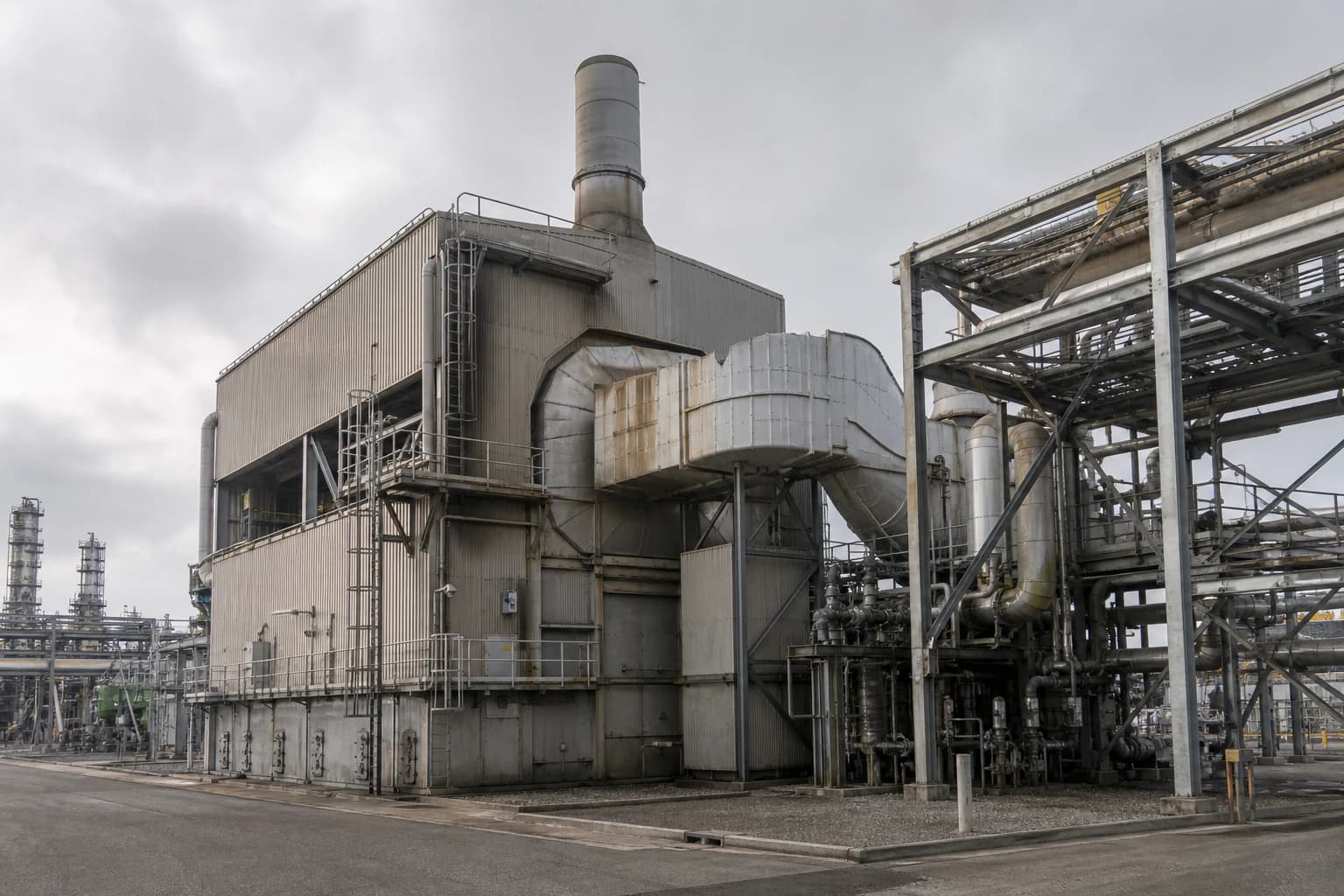
Why Refineries Set a 20-40°C Minimum Approach Temperature
Pinch Analysis shows how lower ΔTmin can increase fouling and shorten refinery run lengths.
A crude preheat train can recover 60-70% of the thermal energy required before crude reaches the fired heater, but each increment of recovery competes with exchanger area, pressure drop and fouling risk. That is why refinery pinch studies commonly begin with a 20-40°C minimum approach temperature refinery heat exchanger target rather than pursuing the smallest thermodynamically possible temperature difference.
The figure is a design starting point, not a universal rule. A 20°C target may suit a valuable recovery opportunity with favourable heat-transfer coefficients and a manageable cleaning strategy. A 40°C target can be the better commercial choice where viscous crude, heavy residues, limited plot space or a short shutdown window make a close approach expensive to install and difficult to sustain.
For process engineers, the question is not whether a lower minimum approach temperature saves fuel. It does. The decision is whether the lifetime value of that fuel saving exceeds the installed and operating cost of achieving it.
What minimum approach temperature means in refinery pinch analysis
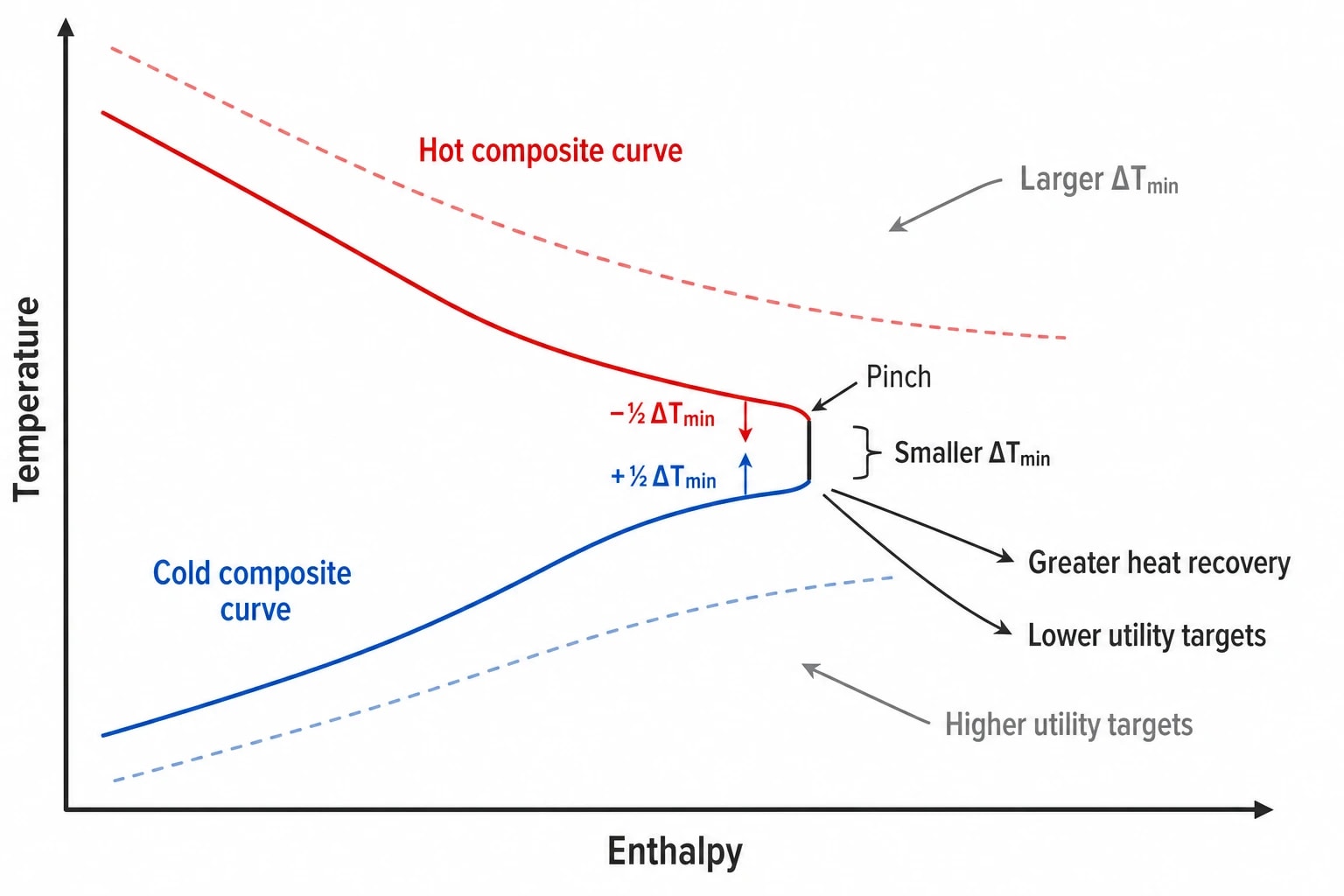
Minimum approach temperature, written as ΔTmin, is the smallest temperature difference permitted between hot and cold process streams in a pinch-analysis model. It is the practical driving force available for heat transfer across the heat exchanger network.
A smaller ΔTmin allows the composite curves to move closer together. The model then identifies greater internal heat recovery and lower hot- and cold-utility targets. A larger ΔTmin separates the curves, reduces recoverable process heat and increases utility demand.
ΔTmin is a network target, not just an exchanger reading
A refinery heat exchanger has local temperature differences at each end and a calculated logarithmic mean temperature difference across the heat exchanger. Pinch analysis uses ΔTmin differently: it applies a temperature constraint to establish the theoretical energy target for the whole network.
That distinction matters in a crude distillation unit. One heat exchanger may have a generous temperature driving force while another controls the network pinch. Engineers should not take a 30°C global target to mean that every shell-and-tube heat exchanger must operate at exactly 30°C at both ends.
The global target sets the level of heat recovery the network should seek before detailed heat-exchanger design begins.
The shifted-temperature method
Traditional pinch analysis shifts hot streams down and cold streams up by half of the selected ΔTmin. The resulting composite curves identify:
- Minimum hot-utility demand.
- Minimum cold-utility demand.
- The pinch temperature.
- The heat-recovery limit before network design.
- Utility levels that match the process temperature profile.
A lower ΔTmin shifts the curves by a smaller amount and reveals more theoretical recovery. That result is useful, but it is only the first part of the investment decision. Area, heat-exchanger configuration, allowable pressure drop, fouling allowance and operating flexibility determine whether the target is worth building.

Pinch analysis identifies the thermodynamic minimum energy requirement of your process — then designs the heat exchanger network to achieve it.
Why 20-40°C is common in refinery heat exchanger design
Linnhoff March guidance for refinery studies places crude distillation units, fluid catalytic cracking units and many hydroprocessing units in the 30-40°C range, while vacuum distillation units may use 20-30°C. The difference reflects individual process temperature profiles and heat-transfer characteristics.
A 20-40°C range suits refinery service. Many recovery heat exchangers use shell-and-tube construction, process-stream viscosity can vary sharply, and crude-feed quality changes over the operating cycle.
Shell-and-tube economics favour a moderate driving force
For a fixed duty, a smaller temperature driving force generally requires more heat-transfer surface. More surface can mean longer bundles, additional shells, larger channel heads, more supports, more piping and a more difficult retrofit.
The capital effect is not linear. A close approach may force a different heat-exchanger arrangement or require several additional heat exchangers to accommodate bundle length, pressure-drop and maintenance constraints. Installed cost can rise sharply for a modest reduction in fired-heater duty.
A 20-40°C minimum approach temperature often keeps the network within familiar shell-and-tube design practice. It leaves enough temperature difference to transfer heat without making every match surface-area intensive.
Refinery streams are not uniform heat-transfer services
A crude preheat train can contain desalted crude, pump-arounds, product streams, reflux streams and residue-derived hot streams. Their film heat-transfer coefficients differ markedly. Light hydrocarbon vapours or condensing services can transfer heat readily. Viscous liquid streams and refinery bottoms can be far less forgiving.
The same 20°C target therefore has different consequences for different matches. A close approach involving a clean condensing stream may need modest area. A close approach involving a viscous, foul-prone crude-side stream may require disproportionate surface and still lose performance quickly.
A refinery-wide 20°C target should not become an automatic specification for every heat exchanger.
The capital versus utility cost trade-off
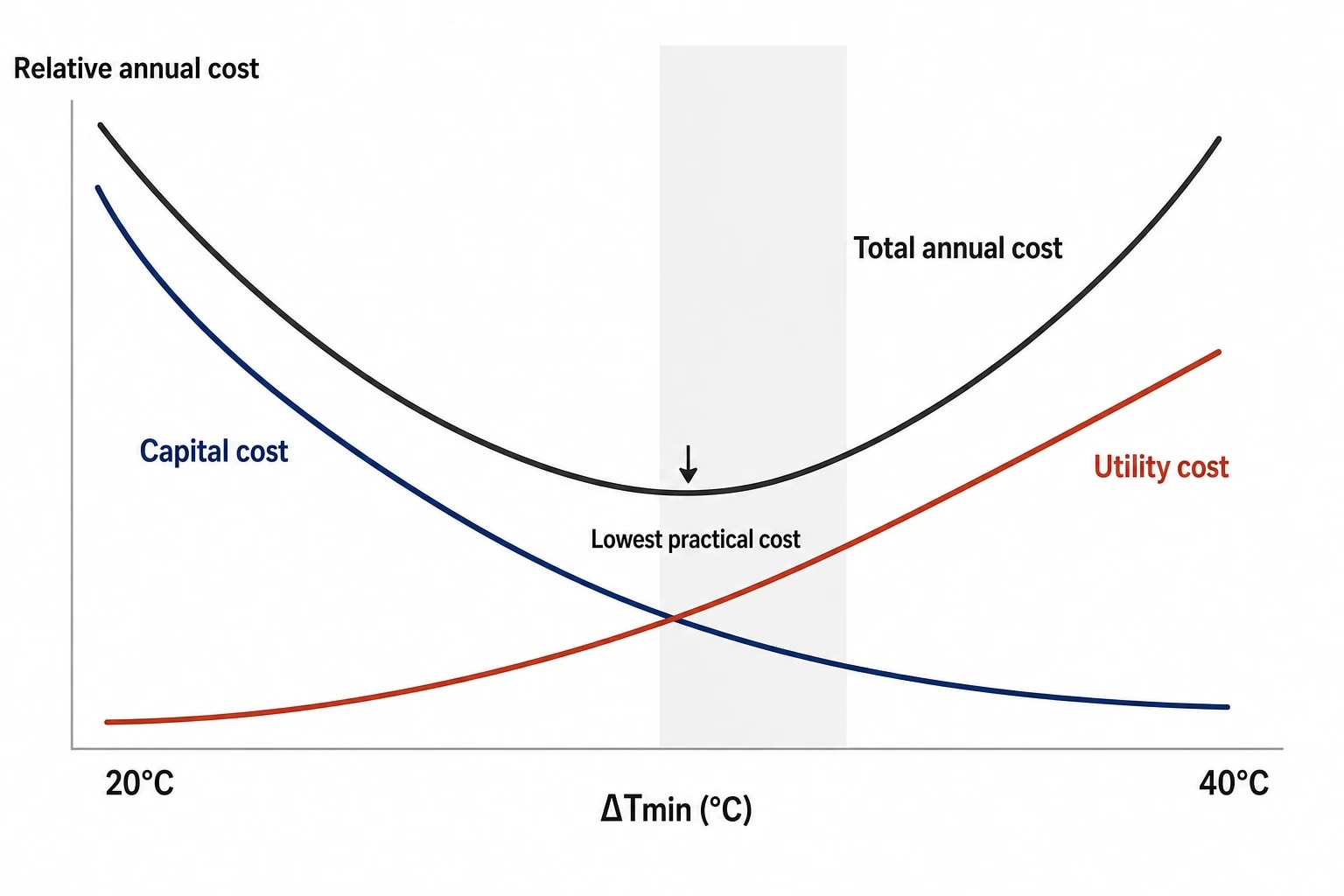
Minimum approach temperature selection is a total-cost exercise. The capital curve rises as ΔTmin falls, while the utility-cost curve rises as ΔTmin increases. The preferred target sits near the lowest practical total annual cost after maintenance and availability are considered.
What becomes more expensive below 20°C
A low ΔTmin can increase cost through several connected mechanisms:
- Larger heat-transfer area and higher heat-exchanger purchase cost.
- Extra shells or heat exchangers to meet duty and pressure-drop limits.
- Larger plot requirements and more complex piping in a retrofit.
- Additional pumping power where velocity or pressure drop must rise.
- More difficult control where closely coupled streams have little temperature margin.
- Higher exposure to lost recovery as fouling resistance accumulates.
The initial pinch target should include installed cost, not only bare heat-exchanger cost. In a congested refinery, tie-ins, structural work, pipe-rack changes, isolation, access and turnaround execution can dominate the economics of an additional heat exchanger.
What becomes more expensive above 40°C
A high ΔTmin reduces heat-exchanger area, but it leaves usable process heat unrecovered. The fired heater must supply more duty, while cooling systems reject more heat elsewhere in the network.
For a crude unit, that can mean higher refinery-fuel consumption and a larger combustion-emissions burden. It can also constrain throughput where the fired heater, stack, burners or furnace duty already limit operation.
The EU refining BAT conclusions, Commission Implementing Decision (EU) 2014/738, identify energy efficiency and heat and power recovery as core elements of refinery environmental performance. A refinery therefore needs a defensible basis for accepting a high ΔTmin where it locks in avoidable fired-heater duty for the life of an asset.
The economic direction of travel
| ΔTmin choice | Heat recovery and utility demand | Exchanger and installation impact | Typical commercial risk |
|---|---|---|---|
| Lower, near 20°C | Higher recovery, lower fired-heater and cooling duty | Larger area, tighter hydraulic and layout constraints | Fouling and complex retrofit costs erase forecast savings |
| Middle of the range | Balanced recovery and surface requirement | Usually compatible with conventional refinery heat-exchanger practice | Requires case-specific checks of fuel, carbon and maintenance cost |
| Higher, near 40°C | Lower recovery, higher utility demand | Smaller, simpler heat-exchanger network | Persistent fuel cost and emissions from unrecovered process heat |
Fuel price, carbon cost, electricity price, refinery-fuel balance and turnaround economics can move the optimum. The target should be recalculated when any of those inputs changes materially.
Fouling is why theoretical recovery can disappoint
Fouling turns the minimum approach temperature calculation for refinery heat exchangers from a clean-design problem into a time-dependent operating problem. Deposits add thermal resistance, reduce overall heat-transfer performance and often increase pressure drop.
In crude preheat trains, fouling does not merely reduce one heat exchanger’s duty. It changes temperatures through the network. The fired heater then compensates for a lower crude inlet temperature, increasing fuel use. If pressure drop becomes restrictive or a bundle must be removed for cleaning, production and maintenance costs enter the calculation.
A close approach leaves little operating margin
A clean heat exchanger designed around a very small terminal temperature difference has little spare driving force. As fouling develops, the heat exchanger needs either more area, more temperature difference or a longer heat-transfer path to sustain duty. Existing heat exchangers rarely have all three available.
Heavy crude service compounds the effect. Deposits can develop from particulate fouling, inorganic salts, corrosion products and organic material. The precise mechanism depends on crude blend, desalter performance, temperatures, local shear conditions and residence time.
Lower velocities may reduce pressure drop, but they can also reduce wall shear. In fouling-prone service, that trade-off can make a low-ΔTmin design commercially fragile. A design study should test the velocity range and anticipated fouling resistance rather than treating a clean overall heat-transfer coefficient as an operating guarantee.
Design for run length, not day-one performance
A useful refinery assessment considers several operating states:
- Clean conditions immediately after turnaround.
- Expected mid-run fouling conditions.
- End-of-run conditions before planned cleaning.
- A credible severe-fouling case associated with a changed crude diet or desalter upset.
For each state, the study should recalculate crude-coil inlet temperature, fired-heater duty, heat-exchanger pressure drop, utility use and critical temperature approaches. This reveals whether a low ΔTmin target delivers repeatable savings or only an attractive clean-condition simulation.
Published refinery case work has linked severe preheat-train fouling to lower pump-around recovery and increased fuel-gas consumption in fired heaters and reboilers.

Pinch analysis identifies the thermodynamic minimum energy requirement of your process — then designs the heat exchanger network to achieve it.
How to select a refinery minimum approach temperature
A practical study evaluates a range, not a single assumed number. For a conventional crude unit or refinery process unit, an initial screen might include 20°C, 25°C, 30°C, 35°C and 40°C.
Build the model from reconciled operating data
Pinch targets are only as good as the stream data. Process teams should establish temperatures, flowrates, heat capacities, phase behaviour, pressure constraints and utility conditions from reconciled plant data or a verified process model.
The data set should distinguish between:
- Design and actual throughput.
- Seasonal cooling-water conditions.
- Current and forecast crude slates.
- Clean and fouled heat-exchanger performance.
- Maximum allowable pressure drop.
- Fired-heater duty and stack constraints.
- Maintenance access and available spare bundles.
A network based only on design conditions can overstate recovery where current crudes are heavier or heat-exchanger performance has deteriorated.
Annualise the right costs
The economic comparison should annualise more than utility savings. It should include heat-exchanger purchase and installation, civil and piping work, additional pumping electricity, inspection, cleaning, expected production impact and turnaround exposure.
The model should use site fuel value rather than an arbitrary gas price. It should also account for the marginal emissions effect of increased heater firing where relevant to a site’s carbon-cost assumptions and permit obligations.
ISO 50001:2018 provides a management framework for tracking energy performance, setting baselines and verifying results after a heat-integration project. It does not prescribe a ΔTmin. The refinery must establish the target from its duty, costs, reliability requirements and operating envelope.
Test the proposed network before committing
Pinch targeting identifies opportunity. Detailed design must then test whether the candidate heat-exchanger network remains operable.
Questions worth resolving include:
- Does the match violate pressure-drop limits at design and turndown flow?
- Can the crude-side velocity support the intended fouling strategy?
- Does the network preserve stable column, desalter and fired-heater control?
- Are isolation, bypassing and cleaning arrangements practical?
- Does a new match create an unacceptable temperature cross during fouled operation?
- Can the tie-ins be completed inside the available turnaround?
A slightly higher ΔTmin can be the stronger investment if it avoids extra heat-exchanger shells, removes a difficult tie-in or lengthens the cleaning interval.
Why a single global ΔTmin can be too blunt
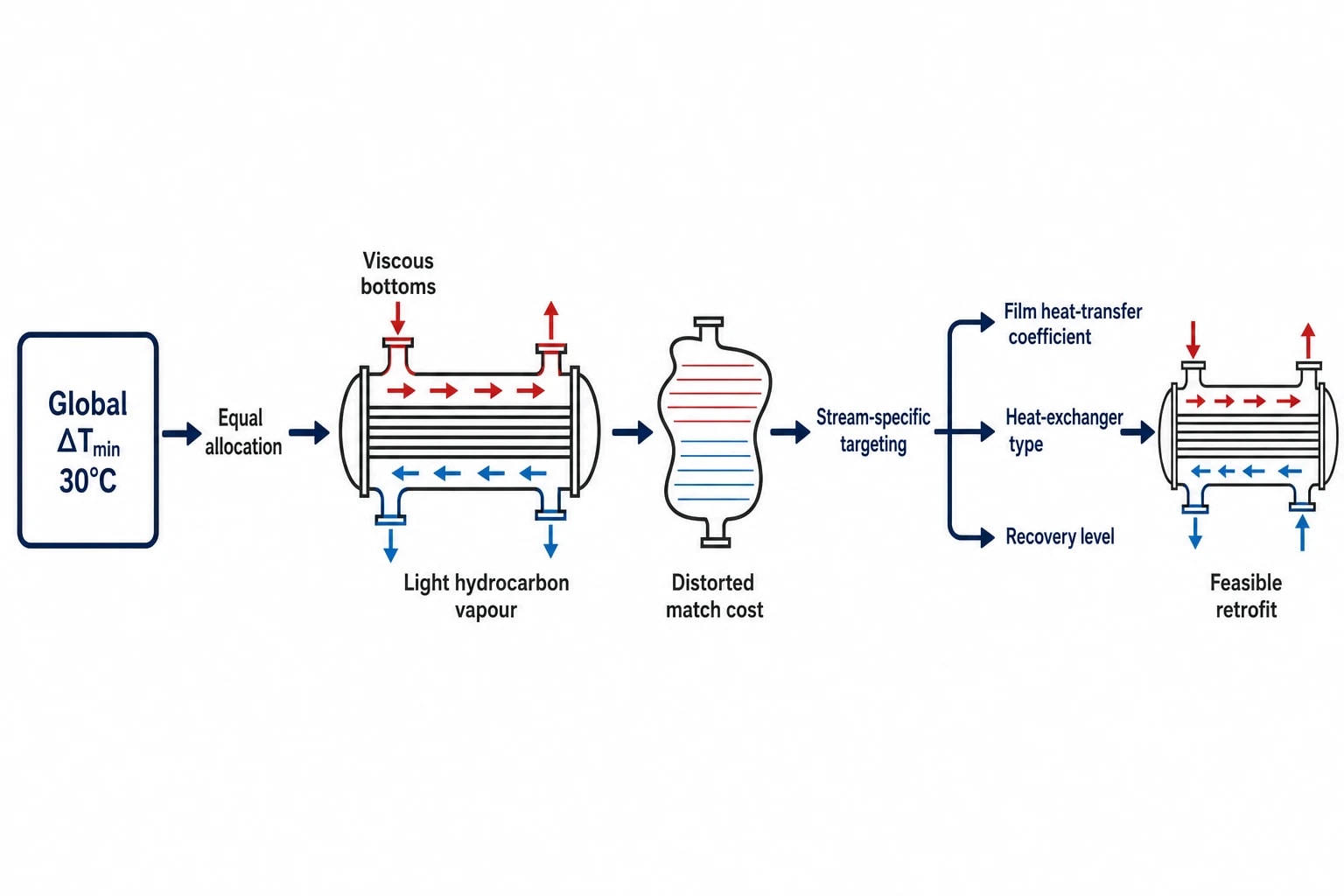
A global 30°C target gives a fast, comparable screening result. It can also distort the real cost of a refinery network when stream heat-transfer characteristics differ widely.
Use stream-specific temperature contributions where justified
Advanced pinch methods allow individual streams to carry different temperature contributions rather than assigning half of one global ΔTmin to every hot and cold stream. The contribution can reflect film heat-transfer coefficient, heat-exchanger type and the desired level of recovery.
This treatment is valuable where a network pairs viscous refinery bottoms with light hydrocarbon vapours or condensing services. A single global target may overstate the area needed for one match and understate it for another. Stream-specific targeting brings the energy target closer to the physical cost of the heat-exchanger matches.
The method does not remove the need for detailed design. It improves the early economic picture by recognising that the cost of one degree of approach temperature differs across streams.
Avoid topology traps in retrofit studies
A global target can steer synthesis towards a theoretically neat network that needs awkward stream splits, long pipe runs or excessive area on poor heat-transfer matches. Retrofit work should therefore compare the target with feasible network structures, plot-plan constraints and operating cases.
The most valuable retrofit may not reach the lowest theoretical utility target. It may instead add a small number of high-value matches with acceptable area, fouling exposure and controllability.
The refinery case for 20-40°C
A 20-40°C ΔTmin is a commercial range for refinery pinch analysis. It recognises that recovered heat has value, but that a close temperature approach carries an escalating cost in heat-exchanger area and operating vulnerability.
Start near the middle of the range, then test lower and higher cases with current fuel value, carbon assumptions, fouling behaviour, pressure-drop limits and shutdown costs. Move towards 20°C only where detailed assessment demonstrates durable heat transfer and a credible maintenance strategy. Move towards 40°C where the added surface or fouling risk outweighs the lifetime utility benefit.
This article reflects the independent analysis and editorial opinion of EnerTherm Engineering. Product names, trademarks, and brands mentioned belong to their respective owners. EnerTherm Engineering is not affiliated with, endorsed by, or a licensee of any third-party software or product mentioned unless explicitly stated.

Managing Director — EnerTherm Engineering
Dr. François Pierrel is Managing Director of EnerTherm Engineering with over two decades of expertise in thermal design, heat transfer, and industrial energy optimisation. He holds a PhD in Heat Transfer from Cranfield University and a Post-Doctorate from Heriot-Watt University.
